Friday, June 25, 2010
Cemeteries: A Matter of Setting Boundaries
Tuesday, June 22, 2010
Dust Jacket Plotting
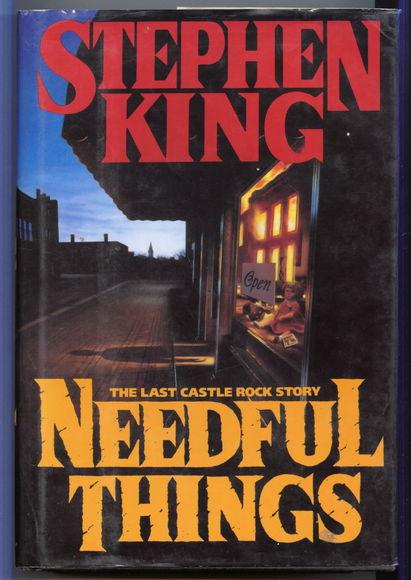
Needful Things: The Last Castle Rock Story
With a demonic blend of malice and affection, Stephen King says goodbye to the town he put on the map--Castle Rock, Maine. . . where Polly Chalmers runs You Sew and Sew and Sheriff Alan Pangborn is in charge of keeping the peace. It’s a small town, and Stephen King fans might think they know its secrets pretty well: they’ve been here before. Leland Grant is a stranger--and he calls his shop Needful Things. Eleven-year-old Brian Rusk is his first customer, and Brian finds just what he wants most in all the world: a ‘56 Sandy Koufax baseball card. By the end of the week, Mr. Gaunt’s business is fairly booming, and why not? At Needful Things, there’s something for everyone. And, of course, there is always a price. For Leland Gaunt, the pleasure of doing business lies chiefly in seeing how much people will pay for their most secret dreams and desires. And as Leland Gaunt always points out, at Needful Things, the prices are high in deed. Does that stop people from buying? Has it ever?
For Allan and Polly, this one week in autumn will be an awful test--a test of will, desire, and pain. Above all, it will be a test of their ability to grasp the true nature of their enemy. They may have a chance. . . But maybe not, because, as Mr. Gaunt knows, almost everything is for sale: love, hope, even the human soul. With the potent storytelling authority that millions of readers have come to prize, Stephen King delivers an Our Town with a vengeance, an inimitable farewell to a place his fiction has often and long called home.
#1 New York Times bestselling author Dean Koontz delivers a thrilling novel of suspense and adventure, as the lives of strangers converge around a mystery unfolding high in the Colorado mountains--and the balance of the world begins to tilt. . . .
Breathless
In the stillness of a golden September afternoon, deep in the wilderness of the Rockies, a solitary craftsman, Grady Adams, and his magnificent Irish wolfhound, Merlin, step from shadow into light. . . and into an encounter with enchantment. That night, through the trees, under the moon, a pair of singular animals will watch Grady’s isolated home, waiting to make their approach. A few miles away, Camilla Rivers, a local veterinarian, begins to unravel the threads of a puzzle that will bring to her door all the forces of a government in peril. At a nearby farm, long-estranged identical twins come together to begin a descent into darkness. . . . In Las Vegas, a specialist in chaos theory probes the boundaries of the unknowable. . .. On a Seattle golf course, two men make matter-of-fact arrangements for murder. . . . Along a highway by the sea, a vagrant scarred by the past begins a trek toward his destiny. In a novel that is at once wholly of our time and timeless, fearless and funny, Dean Koontz takes readers into the moment between one turn of the world and the next, across the border between knowing and mystery. It is a journey that will leave all who take it Breathless.
Although Crystal Fall, her not-so-secret admirer David Lewis, and their friends Fran Newell and Dee Dee Dawkins crack jokes and behave in the silly manner characteristic of teens across America, what’s happening at their alma mater, Edgar Allan Poe High School, in southern California is no laughing matter. Their new principal, Dr. Snyder, has introduced changes, both to the school’s curriculum and to the way things are done at Poe, none of them good. For example, he not only lengthens the school days to twelve hours, but he also institutes Saturday school. Once open, the campus is now closed. In fact, it has become more like a prison than a school, with the patrol officers, or “trolls,” as the students call them, guarding the campus and surveillance cameras everywhere--even in the locker rooms and restrooms. An odd dress code is imposed, governing even students’ choice of underwear. Strange, whispered messages are repeated all day in the music piped through the school’s public address system. Students are compelled to eat in the school cafeteria, and a secret ingredient has been added to their food. A student health clinic is planned, wherein hypnotized students will receive mental health evaluations--and brain implants. If the new administration wins, personal freedom will be lost forever, and Crystal and her friends will become the first of an army of brain-dead public servants in a new world order. And the odds seem stacked against the teens, for Principal Snyder is backed by top government officials with unlimited resources, including an endless supply of funds and military forces. But the teens are willing, even at the cost of great personal sacrifice, or even death, to take back their school, and Crystal and her friends have a secret ally: God is on their side!My blurb numbers 295 words: 48 (paragraph one), 87 (paragraph two), 64 (paragraph three), and 96 (paragraph 4), so the lengths are a bit uneven. Perhaps the text can be shortened a bit without losing the hoped-for appeal of the blurb to prospective readers. The relative lengths, in words, indicate where chopping may best take place: the second and last paragraphs are rather longwinded in comparison to the other two. As a rough draft, though, my novel’s blurb accomplishes the same sorts of things as those for King’s and Koontz’s books. Like their books’ blurbs, mine sets the tone; introduces the major players, including both the protagonist and the antagonist; identifies the basic conflict, implying that it is significant; establishes the setting; and suggests the story’s theme. As a means of getting the novel’s basic outline down on paper in a compelling fashion, it’s a pretty good way to kick-start one’s imagination and get the creative juices flowing. Such a synopsis, although far from the level of detail that a publisher would require, also allows one to expand upon the basic storyline, adding details to fill out the plot, develop the characters, describe the setting, maintain the tone, expand the conflict, and convey the theme. Not bad for fewer than 300 words.
Saturday, June 19, 2010
The Grand Entrance
In another episode, “Lover’s Walk,” the vampire Spike runs over a “Welcome to Sunnydale” street sign as he returns to town.
In “Hell’s Belles,” Xander’s future self (or supposed future self) arrives at his younger self’s wedding to warn Xander not to go through with his marriage to former vengeance demon Anyanka Jenkins. The elder Xander makes his appearance carrying a bright red umbrella.
When Buffy goes to Sunnydale’s bus station in search of the male foreign exchange student who is supposed to stay with her and her mother, Joyce, during his visit to the golden state, she is surprised (as is the show’s audience) to discover that the student, Ampata, is a girl (“Inca Mummy Girl”).
Kendra Young, another slayer, activated, so to speak, upon Buffy’s earlier (and temporary) demise, is mistaken for an assassin, come to kill Buffy (whom Kendra herself mistakes for a vampire after she observes Buffy kissing her vampire boyfriend Angel) (“What‘s My Line, Part I”).
“Faith, Hope, and Trick” introduces not only the slayer Faith who is called after Kendra’s death at the hands of the vampire Drusilla, but the episode also introduces viewers to Faith’s nemesis, an ancient vampire named Kakistos and to his henchman, Mr. Trick, another, lesser vampire. As Faith dances with a young man at Sunnydale’s teen nightclub, The Bronze, his outdated dance moves make Buffy suspicious. Thinking he may be a vampire, Buffy follows him outside when he leaves with his dance partner, only to be astonished to see how quickly and easily the dark-haired beauty dispatches the fiend when he does attack her. Obviously, a new slayer has arrived in town. Earlier, Mr. Trick, chauffeuring Kakistos, orders a soda at the drive-through window of a local fast-food restaurant. Becoming hungry when Kakistos talks about devouring the slayer, Mr. Trick decides to pick up some food to go, and he drags the terrified restaurant clerk through the window, into the limousine.
What these scenes and incidents have in common is that each of them represents a grand entrance of sorts for the characters they introduce. By bringing a new character on the scene in an unusual, dramatic manner, rather than simply having him or her make an appearance in an ordinary, banal way, the series’ writers make the new characters stand out from everyone and everything else, and, from the very outset, these characters are memorable.
Once characters are established as regular or recurring members of the cast, viewers aren’t allowed to take them for granted. Through witty dialogue, the show’s writers keep viewers interested in the characters as the dramatic personae continuously deliver hilarious, often characteristic lines.
Narcissistic Cordelia Chase, for instance, after running over a fellow student during Driver’s Education class and breaking the girl’s leg, exclaims, “It’s the worst day of my life, and she’s trying to make it about her leg” (“Out o Sight, Out of Mind”). In another episode, Cordelia says, “Look, Buffy, you may be hot stuff when it comes to demonology or whatever, but when it comes to dating, I’m the slayer” (“Halloween”).
Xander, likewise, is full of comical one-liners, many of them targeting Cordelia’s vanity and arrogance: in reply to her question, asked while she’s complaining about having been awakened to give him a ride to Buffy’s house, “What am I now, mass transportation?” he quips, “That’s what a lot of the guys say, but it’s just locker room talk” (“What’s My Line, Part I”). Regarding a skimpy outfit Cordelia wears, Xander remarks, “I don’t know what everyone’s talking about, Cordelia. That outfit doesn’t make you look like a hooker” (“The Zeppo”).
The series has much to teach writers, and the importance of having a new character make a grand entrance and of keeping him or her interesting throughout the story (or series) by putting witty words in their mouths are two lessons that the show imparts to discerning viewers who want to be beguiling writers. In a later post, we’ll look at a few of the show’s other narrative techniques.
Friday, June 18, 2010
Equating “This” with “That”
Paranormal vs. Supernatural: What’s the Diff?
Sometimes, in demonstrating how to brainstorm about an essay topic, selecting horror movies, I ask students to name the titles of as many such movies as spring to mind (seldom a difficult feat for them, as the genre remains quite popular among young adults). Then, I ask them to identify the monster, or threat--the antagonist, to use the proper terminology--that appears in each of the films they have named. Again, this is usually a quick and easy task. Finally, I ask them to group the films’ adversaries into one of three possible categories: natural, paranormal, or supernatural. This is where the fun begins.
It’s a simple enough matter, usually, to identify the threats which fall under the “natural” label, especially after I supply my students with the scientific definition of “nature”: everything that exists as either matter or energy (which are, of course, the same thing, in different forms--in other words, the universe itself. The supernatural is anything which falls outside, or is beyond, the universe: God, angels, demons, and the like, if they exist. Mad scientists, mutant cannibals (and just plain cannibals), serial killers, and such are examples of natural threats. So far, so simple.
What about borderline creatures, though? Are vampires, werewolves, and zombies, for example, natural or supernatural? And what about Freddy Krueger? In fact, what does the word “paranormal” mean, anyway? If the universe is nature and anything outside or beyond the universe is supernatural, where does the paranormal fit into the scheme of things?
According to the Online Etymology Dictionary, the word “paranormal,” formed of the prefix “para,” meaning alongside, and “normal,” meaning “conforming to common standards, usual,” was coined in 1920. The American Heritage Dictionary defines “paranormal” to mean “beyond the range of normal experience or scientific explanation.” In other words, the paranormal is not supernatural--it is not outside or beyond the universe; it is natural, but, at the present, at least, inexplicable, which is to say that science cannot yet explain its nature. The same dictionary offers, as examples of paranormal phenomena, telepathy and “a medium’s paranormal powers.”
Wikipedia offers a few other examples of such phenomena or of paranormal sciences, including the percentages of the American population which, according to a Gallup poll, believes in each phenomenon, shown here in parentheses: psychic or spiritual healing (54), extrasensory perception (ESP) (50), ghosts (42), demons (41), extraterrestrials (33), clairvoyance and prophecy (32), communication with the dead (28), astrology (28), witchcraft (26), reincarnation (25), and channeling (15); 36 percent believe in telepathy.
As can be seen from this list, which includes demons, ghosts, and witches along with psychics and extraterrestrials, there is a confusion as to which phenomena and which individuals belong to the paranormal and which belong to the supernatural categories. This confusion, I believe, results from the scientism of our age, which makes it fashionable for people who fancy themselves intelligent and educated to dismiss whatever cannot be explained scientifically or, if such phenomena cannot be entirely rejected, to classify them as as-yet inexplicable natural phenomena. That way, the existence of a supernatural realm need not be admitted or even entertained. Scientists tend to be materialists, believing that the real consists only of the twofold unity of matter and energy, not dualists who believe that there is both the material (matter and energy) and the spiritual, or supernatural. If so, everything that was once regarded as having been supernatural will be regarded (if it cannot be dismissed) as paranormal and, maybe, if and when it is explained by science, as natural. Indeed, Sigmund Freud sought to explain even God as but a natural--and in Freud’s opinion, an obsolete--phenomenon.
Meanwhile, among skeptics, there is an ongoing campaign to eliminate the paranormal by explaining them as products of ignorance, misunderstanding, or deceit. Ridicule is also a tactic that skeptics sometimes employ in this campaign. For example, The Skeptics’ Dictionary contends that the perception of some “events” as being of a paranormal nature may be attributed to “ignorance or magical thinking.” The dictionary is equally suspicious of each individual phenomenon or “paranormal science” as well. Concerning psychics’ alleged ability to discern future events, for example, The Skeptic’s Dictionary quotes Jay Leno (“How come you never see a headline like 'Psychic Wins Lottery'?”), following with a number of similar observations:
Psychics don't rely on psychics to warn them of impending disasters. Psychics don't predict their own deaths or diseases. They go to the dentist like the rest of us. They're as surprised and disturbed as the rest of us when they have to call a plumber or an electrician to fix some defect at home. Their planes are delayed without their being able to anticipate the delays. If they want to know something about Abraham Lincoln, they go to the library; they don't try to talk to Abe's spirit. In short, psychics live by the known laws of nature except when they are playing the psychic game with people.In An Encyclopedia of Claims, Frauds, and Hoaxes of the Occult and Supernatural, James Randi, a magician who exercises a skeptical attitude toward all things alleged to be paranormal or supernatural, takes issue with the notion of such phenomena as well, often employing the same arguments and rhetorical strategies as The Skeptic’s Dictionary.
In short, the difference between the paranormal and the supernatural lies in whether one is a materialist, believing in only the existence of matter and energy, or a dualist, believing in the existence of both matter and energy and spirit. If one maintains a belief in the reality of the spiritual, he or she will classify such entities as angels, demons, ghosts, gods, vampires, and other threats of a spiritual nature as supernatural, rather than paranormal, phenomena. He or she may also include witches (because, although they are human, they are empowered by the devil, who is himself a supernatural entity) and other natural threats that are energized, so to speak, by a power that transcends nature and is, as such, outside or beyond the universe. Otherwise, one is likely to reject the supernatural as a category altogether, identifying every inexplicable phenomenon as paranormal, whether it is dark matter or a teenage werewolf. Indeed, some scientists dedicate at least part of their time to debunking allegedly paranormal phenomena, explaining what natural conditions or processes may explain them, as the author of The Serpent and the Rainbow explains the creation of zombies by voodoo priests.
Based upon my recent reading of Tzvetan Todorov's The Fantastic: A Structural Approach to the Fantastic, I add the following addendum to this essay.
According to Todorov:
The fantastic. . . lasts only as long as a certain hesitation [in deciding] whether or not what they [the reader and the protagonist] perceive derives from "reality" as it exists in the common opinion. . . . If he [the reader] decides that the laws of reality remain intact and permit an explanation of the phenomena described, we can say that the work belongs to the another genre [than the fantastic]: the uncanny. If, on the contrary, he decides that new laws of nature must be entertained to account for the phenomena, we enter the genre of the marvelous (The Fantastic: A Structural Approach to a Literary Genre, 41).Todorov further differentiates these two categories by characterizing the uncanny as “the supernatural explained” and the marvelous as “the supernatural accepted” (41-42).
Interestingly, the prejudice against even the possibility of the supernatural’s existence which is implicit in the designation of natural versus paranormal phenomena, which excludes any consideration of the supernatural, suggests that there are no marvelous phenomena; instead, there can be only the uncanny. Consequently, for those who subscribe to this view, the fantastic itself no longer exists in this scheme, for the fantastic depends, as Todorov points out, upon the tension of indecision concerning to which category an incident belongs, the natural or the supernatural. The paranormal is understood, by those who posit it, in lieu of the supernatural, as the natural as yet unexplained.
And now, back to a fate worse than death: grading students’ papers.
My Cup of Blood
Anyway, this is what I happen to like in horror fiction:
Small-town settings in which I get to know the townspeople, both the good, the bad, and the ugly. For this reason alone, I’m a sucker for most of Stephen King’s novels. Most of them, from 'Salem's Lot to Under the Dome, are set in small towns that are peopled by the good, the bad, and the ugly. Part of the appeal here, granted, is the sense of community that such settings entail.
Isolated settings, such as caves, desert wastelands, islands, mountaintops, space, swamps, where characters are cut off from civilization and culture and must survive and thrive or die on their own, without assistance, by their wits and other personal resources. Many are the examples of such novels and screenplays, but Alien, The Shining, The Descent, Desperation, and The Island of Dr. Moreau, are some of the ones that come readily to mind.
Total institutions as settings. Camps, hospitals, military installations, nursing homes, prisons, resorts, spaceships, and other worlds unto themselves are examples of such settings, and Sleepaway Camp, Coma, The Green Mile, and Aliens are some of the novels or films that take place in such settings.
Anecdotal scenes--in other words, short scenes that showcase a character--usually, an unusual, even eccentric, character. Both Dean Koontz and the dynamic duo, Douglas Preston and Lincoln Child, excel at this, so I keep reading their series (although Koontz’s canine companions frequently--indeed, almost always--annoy, as does his relentless optimism).
Atmosphere, mood, and tone. Here, King is king, but so is Bentley Little. In the use of description to terrorize and horrify, both are masters of the craft.
Innovation. Bram Stoker demonstrates it, especially in his short story “Dracula’s Guest,” as does H. P. Lovecraft, Edgar Allan Poe, Shirley Jackson, and a host of other, mostly classical, horror novelists and short story writers. For an example, check out my post on Stoker’s story, which is a real stoker, to be sure. Stephen King shows innovation, too, in ‘Salem’s Lot, The Shining, It, and other novels. One might even argue that Dean Koontz’s something-for-everyone, cross-genre writing is innovative; he seems to have been one of the first, if not the first, to pen such tales.
Technique. Check out Frank Peretti’s use of maps and his allusions to the senses in Monster; my post on this very topic is worth a look, if I do say so myself, which, of course, I do. Opening chapters that accomplish a multitude of narrative purposes (not usually all at once, but successively) are attractive, too, and Douglas Preston and Lincoln Child are as good as anyone, and better than many, at this art.
A connective universe--a mythos, if you will, such as both H. P. Lovecraft and Stephen King, and, to a lesser extent, Dean Koontz, Bentley Little, and even Douglas Preston and Lincoln Child have created through the use of recurring settings, characters, themes, and other elements of fiction.
A lack of pretentiousness. Dean Koontz has it, as do Douglas Preston and Lincoln Child, Bentley Little, and (to some extent, although he has become condescending and self-indulgent of late, Stephen King); unfortunately, both Dan Simmons and Robert McCammon have become too self-important in their later works, Simmons almost to the point of becoming unreadable. Come on, people, you’re writing about monsters--you should be humble.
Longevity. Writers who have been around for a while usually get better, Stephen King, Dan Simmons, and Robert McCammon excepted.