Sunday, March 22, 2009

Mapping the Monstrous

Copyright 2009 by Gary L. Pullman


In Monster (2005), Frank Peretti includes a map of his novel’s setting, which he updates at the end of each chapter. His use of this device accomplishes several narrative purposes. It orients the reader as to what takes place, when, where, and to whom, even as characters’ actions and narrative events change. It thus reinforces the idea that something is happening, that actions and events are unfolding. The map also adds verisimilitude, or a sense of reality, to the story, for its narrative landscape is charted, just as a real-world stretch of territory might be. The map also implies that the action of the narrative is significant, because only important events are recorded on a map.

The publisher of Monster notes, in a word to the reader, that the novel’s “custom maps,” updated “at the end of each chapter,” are included “to help you keep track of all the action.” So much action occurs between the novel’s covers, the publisher’s statement suggests, that the reader will need a visual representation of the setting just “to keep track” of it all. However, the publisher also suggests that, “even with maps. . . you will still find it hard to guess where things are headed.” The map, in other words, may orient the reader, but it will certainly not inhibit the plot’s imaginative meanderings, and, the maps notwithstanding, one should expect the unexpected: “Just when you think you have things figured out, Peretti’s imagination takes you down an unexpected route. . . and you realize there are more layers to the story than you imagined.”

A map, as Wikipedia observes, “is a visual representation of an area” which emphasizes “relationships between elements” that share a common space. Of course, there are many types of maps--aeronautical charts, contour maps, political maps, nautical charts, road atlases, pictorial maps, and others--but each is a depiction of a region, often terrestrial. That is, they enclose a space, thereby framing it, as it were, and making it special.

Maps cannot show every feature of the territory to which they correspond, so the mapmaker must select those features that the map will include, meaning, of course, that others must be excluded. In including some, while excluding other, features of the environment, the cartographer creates an image of the true world, and, of course, the mapmaker could be honest and straightforward or devious and duplicitous in depicting the terrain, its features, and their relationships to one another. A map is only as reliable as its maker. In other words, a map, like a storyteller, can be, as it were, an unreliable narrator.

Maps are often (but not always) scaled, so that an inch of map surface represents a much larger, corresponding surface of the actual terrain that the map represents. The map in Monster is scaled such that one inch of map surface equals ten miles of terrestrial surface. (Unfortunately, Peretti does not always honor his map’s scale.)


As the story progresses, more and more features are added, such as would not appear on any ordinary map of the area in which the story takes place--the deep forests of Idaho--suggesting that the novel’s maps are, indeed, as the publisher describes them, “custom maps.” The features that most maps include--highways, a river, creeks, a lake, forests, dry creek beds, trails, a resort, a dangerous “rock face”--are all present and accounted for, forming the relatively stable background, so to speak, against which foreground objects are added, subtracted, and rearranged as the story’s action progresses (although some settlements, towns, and directions to cities that do not themselves appear upon the maps are occasionally added as well). The stable landscape features are the relatively permanent, the more-or-less fixed, the comparatively reliable.

The foreground features, which are mostly technological or manmade, change; they appear, vanish, or reappear in other locations. Against the relatively permanent backdrop of nature, human and technological activities, temporary and tentative, shift and move. Like the scale--and, indeed, the map itself, as a mere “visual representation” of reality--the human attempt to chart the previously unknown--the difference between background and foreground features seems to represent the difference between the fixed and the determinate and the fluid and the free, or between fate and the freedom of the human will, just as it also suggests the gap between the known and the unknown and the monstrous and the human.

The shifting of the symbols on the map suggests that it’s not easy--and it may not even be possible--to truly represent reality, for, despite the stability of the known and the understood and, indeed, of the given features of nature, so to speak, there are always changeable and changing features which represent human freedom and behavior, including the products of
both--technological artifacts.

It would be unfair to divulge the secrets of Peretti’s impressive novel by describing the changes that occur with regard to the foreground objects that his ever-changing “custom maps” depict, for they both offer clues as to the story’s action and the direction that the plot takes. However, for the sake of further elucidating our idea as to the narrative significance of the map in mapping the monstrous, we shall address a couple of these shifting features.

One is the campsite of a young couple, Ted and Melanie, which, represented by a symbol of an Indian teepee in silhouette, doesn’t make its debut on the map until the end of chapter six, at the end of Service Road 19, which makes its first appearance along with the campsite. Both the service road and the teepee remain on subsequent maps, but the label, “Ted & Melanie’s campsite” vanishes, never to be seen again (until the final map, that is, representing, perhaps eternity), signifying that the couple is gone and that their campsite is now merely an abandoned location, not even marked, or labeled, as such anymore (until, again, the last map).

Likewise, at the end of chapter eight, Sing’s mobile lab appears on the map, parked, as it were, alongside the north shoulder of Highway 9, near the settlement labeled “Three Rivers.” On the map at the end of chapter nine, however, the settlement of Three Rivers, represented by a cluster of buildings in silhouette, remains, as does the text that labels it, but Sing’s satellite-dish-equipped van, labeled “Sing’s Mobile Lab,” has been relocated to the east of Road 228, west of Lost Creek and north of Abney & Tall Pine Resort, reflecting the character’s drive south.

Other, more critical objects are also represented, both on previous and subsequent maps as well as this one, but, again, it would be unfair to identify or discuss many of them for fear of spoiling readers’ pleasure in discovering these clues for themselves.

What is clear, however, even without an exhaustive detailing of the symbols’ appearances, disappearances, reappearances, and relocations or removals, is that the use of these “custom maps” adds interest, on several levels, to a novel that is exciting throughout and thrilling at times. The maps seem to help the reader to pin things down, but, as the publisher rightly observes, Peretti, nevertheless, succeeds in surprising the reader, time after time.

A map is not a journey, but it can suggest, at least, the terrain and its features, both relatively permanent and comparatively dynamic, and it can, when it involves a monster, suggest that there may be a disconnect between appearances and reality, between the known and the unknown, between the certain and the dubious, between fact and fiction. The maps in Monster are part of its fictional universe, and they both satisfy and frustrate the reader’s search for meaning and certainty. There is more to life than meets the eye, these maps suggest, and more to be taken upon faith than can be ascertained by reason.

Wednesday, March 18, 2009

The Monsters and Heroes of Fiction (Are The Monsters and Heroes of the Self)

Copyright 2009 by Gary L. Pullman
Resist the devil, and he will flee from you. -- James 4:7

Anything goes wrong in one’s life, from birth to death, can, if properly represented, become a monster, for horror fiction, as we explain in a previous post, is really about suffering and, usually, surviving, loss:

  • The death of a baby = horror; what kills the baby = the monster.
  • The loss of a limb = horror; what causes the loss of the limb = the monster.
  • The loss of an eye or another organ = horror; the cause of the loss of the eye or other organ = the monster.
  • Starvation = horror; the cause of starvation--maybe it’s bulimia or anorexia nervosa--or, more specifically, the emotional roots of such a disease = the monster.
  • Loss of self-esteem = horror; the cause of the loss of self-esteem (abuse, abandonment, rejection?) = the monster.

A monster can produce offspring, many of which will not look like or act as their parents. The monster that kills a baby may cause a mother or a father--or both--to go insane, perhaps transforming a loving parent into a murderer or a suicide--or both. If the monster was a killer, perhaps the parent or parents will become a monster who takes the law into his, her, or their own hands. The abusive mother or father, or the parent who abandons or rejects his or her child may produce a serial killer when the abused, abandoned, or rejected child him- or herself becomes an adult and starts to slaughter and destroy. Perhaps, such a child will become an arsonist instead, or a sadist, or a master manipulator whose violence is subtle and psychological and all the more devastating because unexpected and unperceived. The sins of the father (and mother), the Bible tells us, are visited upon the children, unto the fourth generation. Monsters have parents; they also have progeny. But monsters can be overcome; they can be defeated; sometimes, they can even be killed. Eventually, they meet their match, and they are neutralized or destroyed. The destroyer of monsters is the hero within, the self that is bold enough and strong enough to meet the monster on his, her, or its own terms, on its home turf, and, single-handedly or aided by friends, go hand to hand and toe to toe against the beast. Gilgamesh is such a hero. Hercules is such a hero. Beowulf is such a hero. King Arthur is such a hero. Frodo Baggins is such a hero. Luke Skywalker is such a hero. Buffy Summers is such a hero. Fiction is replete with such heroes, as is life itself, for we--you and I--are potential heroes, just as it is you and I, as often as not, who are also the monsters. The monster is overcome by the hero’s gaining what he or she lacks. The acquisition of this need constitutes his or her transformation, and this transformation indicates his or her victory over the monster. There is no chance of victory for the murdered baby, but there is for the surviving parents; if they resist the temptation to become monsters themselves, they have, despite the loss of their beloved child, defeated the monster. If a person lives the fullest life possible, without self-pity, seeking his or her own welfare and happiness and the welfare and happiness of others as well, despite the loss of a limb, this person has overcome the monster that has lain in ambush for him or her and is a hero rather than a victim. The same is true of the man or woman who loses an eye or another organ. Resisting the demons of despair and self-pity, of helplessness and bitterness means defeating them. Starvation--which can be spiritual or emotional as well as physical--can be defeated if one is able to find the nutrients, whether of the soul or the flesh or both, that he or she lacks or can find the strength of character and will to defeat the monster of bulimia or anorexia nervosa, whatever hell their emotional roots may be planted in. Learning to love and trust others--and oneself--despite having been abused, abandoned, or rejected means overcoming the monster. There are many monsters. They are everywhere. There are many heroes, too, though, for the monster’s nemesis, its slayer, resides within.

Monday, March 16, 2009

Reversals of Fate and Fortune

By Gary L. Pullman

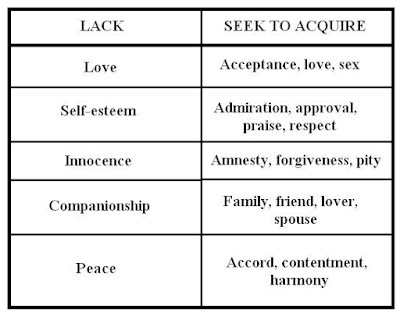
People--and, therefore, their images and likenesses, fictional characters--seek to acquire that which they lack. This is the basic motive in all fiction, for all characters, whatever their more specific, momentary motive or motives may be.

Biologists tell us that organisms, including people, seek to maintain homeostasis, or balance. If they experience a depletion of nutrients, they become hungry and eat, thereby replacing the nutrients they’ve lost. If pressure builds upon the bladder, they seek to relieve this pressure by urinating. If they feel anxious, they seek to find whatever they need to make themselves feel safe and secure. Writers, whether of horror fiction or otherwise, should make sure that, whatever other, more immediate and specific motive with which a character is blessed or cursed causes the character to act, he or she does so to acquire whatever he or she lacks or perceives him- or herself to lack.

Here are a few examples of what characters may lack and seek to acquire; there are many others. Some are not emotional, but material, physical, or social in nature. Often, the basic motive (the acquisition of something that one lacks) is related to a character’s more immediate and specific motive or motives, as we shall see in a moment, when we consider the motives of Marion Crane, of Alfred Hitchcock’s Psycho fame.


As Psycho opens, we learn that Marion is having an affair with Sam Loomis. However, she is dissatisfied with seeing her boyfriend on only an occasional basis, and she pressures him to marry her. He says he is unable to do so, because he owes his ex-wife alimony payments and is also otherwise in debt.


After she leaves Sam, she returns to work, where her boss’ latest client, an oilman, has brought the $40,000 in cash as the payment for a house he is buying outright for his daughter, who is getting married. The oilman’s daughter’s imminent marriage and happiness contrasts sharply with Marion’s unhappy, single state, perhaps worsening it in her eyes. The fact that she works for an employer who cares little for her comfort or needs, as is clear when he tells a client that his office is air-conditioned, but the outer office that Marion shares with a coworker is not, makes it easier, perhaps, for her to make her decision to abscond with the money that her boss asks her to deposit in the bank. With this money, she thinks, she can finance her own marriage and happiness. On the surface, the immediate and specific motive for Marion’s stealing of her employer’s money is to make it possible for her and Sam to wed. On a more basic level, she is seeking to acquire the love and companionship that she lacks. The basic, general and the immediate, specific motives mesh.

What is true of Marion is true of other characters--especially protagonists--as well. What about Norman Bates, the protagonist of Hitchcock’s movie? What is the basic, general need that he lacks, and how is it related to the immediate, specific motives for his actions? Toward the end of the film, a psychiatrist, Dr. Fred Richmond, explains all: Norman feels guilt for having killed his mother, who dominated him while she was alive, and seeks to “erase the crime”--that is, to make amends--by impersonating her, by becoming her. He killed his mother after she took a lover following her husband’s death; since he was jealous of his mother’s boyfriend, the psychiatrist explains, Norman believes that his “mother” would also be jealous of any woman for whom Norman feels an infatuation, which is why, dressed as his mother, he kills Marion (and, presumably, two other women who have disappeared in the vicinity of his motel).

Obviously, Norman lacks innocence, which motivates him to seek to acquire forgiveness by atoning for his crime, matricide, even if, in doing so, he must kill again, to maintain the act by which he seeks to acquire forgiveness--the impersonation of his mother.

What is true of Marion Crane and Norman Bates is true of other characters as well. By making sure that your characters’ basic, general needs, or motives, and their more immediate, specific motives mesh, you will create more fully realized and believable characters than you would if you were to motivate their behavior by only the momentary and particular desire to acquire something that is truly but a means to the end of gaining that which, on the more inclusive and permanent (often emotional or spiritual) level, they lack.

Saturday, March 14, 2009

Small-Town, Rural, and Urban Horrors, or There Goes the Neighborhood!

Copyright 2009 by Gary L. Pullman


Among other topics in his generous introduction, “Contemporary Horror Fiction, 1950-1998,” to Fantasy and Horror: A Critical and Historical Guide to Literature, Illustration, Film, TV, Radio, and the Internet, Stefan Dziemianowicz describes several subgenres of the genre, including dark fantasy, or “quiet horror”; small-town horror; urban horror; and various modern monsters (the child, the mad scientist, ghosts, the werewolf, the vampire, psychopaths and serial killers), giving insightful overviews of the use of each in the horror of the day.

The topic of this post is Dziemianowicz’s perceptions concerning “small-town horror,” “the tale of rural horror,” and “the tale of urban horror.” All quotations are directly from Dziemianowicz’s introductory essay:
The small-town horror story--which encompasses. . . suburban. . . and. . . rural horror--. . . characterized life in postwar America. . . . In the typical suburban horror story, a small community serves as a microcosm of the world.

People of the community live in harmony, or at least a tentatively peaceful coexistence, until an external threat causes social disintegration along the lines of smoldering prejudice or social preferment. . . . Although in a small number of these stories. . . the values that tie the members of a community together prove instrumental to defeating the external threat, the basic small-town horror story offers a paranoid vision of something gone rancid at the core of small-town American life (213).
As examples of such horror stories, Dziemianowicz cites Joan Samson’s The Auctioneer, Ramsey Campbell’s The Hungry Moon, Stephen King’s Needful Things, Ray Bradbury’s Something Wicked This Way Comes, Charles L. Grant’s The Hour of the Oxrun Dead, Ira Levin’s The Stepford Wives, King’s The Regulators, and Robert McCammon’s Stinger (213). These stories follow the storyline of the invasion, which I outlined in an earlier post, the prototypical one of which is Satan’s invasion of the Garden of Eden.
According to Dziemianowicz,
The tale of rural horror takes a more traditional tack, evoking a world of savagery outside the boundaries of the civilized city and suburb. . . . In the modern rural horror story, visitors or new residents find a heart of darkness beneath the quaint and charming darkness of rustic life. The milieu is either home to legendary monsters that terrorize old and new townsfolk alike. . . or hostage to primitive customs and rituals that have preserved its unique character. Frequently, . . . the rural menace embodies the hostility of the community to outsiders, and of the country to the city (213).
Among stories of this type, Dziemianowicz includes in his list of examples “H. P. Lovecraft’s tales of Arkham, Dunwich, and other insular New England communities whose degenerate inhabitants are linked to ancient primal forces”; Owen Brookes’ The Gatherer, Alan Ryan’s The Kill, Thomas Tryon’s Harvest Home, Rob Hardy and Anthony Schaffer’s The Wicker Man, Jack Ketcham’s The Off Season, T. E. D. Klein’s The Ceremonies, and Phil Rickman’s Crybbe (213).
Concerning “the tale of urban horror,” Dziemianowicz observes,
The small-town horror story’s counterpart, the tale of urban horror, tends to make much of the incongruity of primitive horrors taking root in a symbol of modern civilization [i. e., the city]. . . . Even more innovative are those stories that present the city itself as a monstrous incarnation of moral decay, human indifference, and brutal violence. . . . Horrors grow out of the grime, crime, and squalor of the urban landscape. Characters in these stories find themselves in danger of engulfment or absorption by their surroundings (213-214).
This type of horror story, Dziemianowicz says, is exemplified by Levin’s Rosemary’s Baby, Ken Eulo’s The Brownstone, Jeffrey Konvitz’s The Sentinel, Fritz Leiber’s Our Lady of Darkness, Whitney Strieber’s The Wolfen, Ray Garton’s Live Girls, Thomas Monteleone’s Night Train, and Klein’s “Children of the Gods” in the Dark Gods anthology (213-214).
Much contemporary horror fiction is set in small towns, rural communities or locations, and urban centers because these are the places that contemporary people live, and each is a source of horrors characteristic, if not always unique, to itself. One of the sources of enjoyment in such fiction is its insertion of the reader into a world that is familiar, but one in which strange and bizarre incidents occur, seemingly at random, either drawing the folk together or driving them apart or, conversely, allowing the reader a glimpse into life as the other half (or third) lives it.

The country bumpkin can get a peek at the lives of city slickers, or vice versa, or the suburbanite can see how things go among his or her city or country counterparts. It may be reassuring to know that others, elsewhere, live problematic lives in which horror and terror are omnipresent possibilities. Maybe the place where one lives is not all that bad, after all, readers, whether urban, rural, or suburban, may conclude after reading about the lives of their counterparts who have chosen or who are forced to live elsewhere instead of next door. Life may not always be better in the pasture on the other side of the fence, after all.

A well-written story in one of these subgenres, if such subtypes they be, also offers a bit of solace to the reader who does occupy the real-life counterparts to one of these fictional settings. The city resident may face serial killers, rats in the sewer, and the inhumanity of man (and woman) to man (and woman) up close, as it were, and personal, but so does everyone else who lives in New York City, Los Angeles, or Detroit. Misery loves company, and, in cities, large, medium, and small, there are anywhere from several thousand to several million other people in the same boat, as it were (to mix a couple of metaphors).

The same is true, of course, of the city residents’ rural or suburban counterpart; the farmer who tends a hundred-acre farm is isolated, to a degree, perhaps, but there are others of his kind across the country and, indeed, around the world; even a far-flung community, the members of which are separated by acres and miles, is still a community, similar or identical values and practices, concerns and hopes, fears and dreams holding them together. The suburbanite has neighbors--sometimes, one too many (and usually the one next door).

In the “What’s My Line” episode of Buffy the Vampire Slayer, the protagonist, Buffy Summers, having encountered Kendra Young, a second vampire slayer, like herself, as the result of a once-in-a-million-years’ accident of sorts, tells Kendra, “I’m a freak,” to which declaration, Kendra replies, “Not the only freak.”

These two teenage girls, saddled with the responsibility to keep humanity safe from demons, vampires, and other monsters, natural, paranormal, and supernatural, take comfort in the knowledge that they are no longer alone, that they are “not the only freak” any longer. The same is true of the reader of horror stories set in cities, in rural areas, and in suburban housing tracts across the country and around the world, thanks, in large measure, to the sort of fiction that Dziemianowicz cites, “the small-town horror story,” “the tale of rural horror ,” and “the tale of urban horror.”

Paranormal vs. Supernatural: What’s the Diff?

Copyright 2009 by Gary L. Pullman

Sometimes, in demonstrating how to brainstorm about an essay topic, selecting horror movies, I ask students to name the titles of as many such movies as spring to mind (seldom a difficult feat for them, as the genre remains quite popular among young adults). Then, I ask them to identify the monster, or threat--the antagonist, to use the proper terminology--that appears in each of the films they have named. Again, this is usually a quick and easy task. Finally, I ask them to group the films’ adversaries into one of three possible categories: natural, paranormal, or supernatural. This is where the fun begins.

It’s a simple enough matter, usually, to identify the threats which fall under the “natural” label, especially after I supply my students with the scientific definition of “nature”: everything that exists as either matter or energy (which are, of course, the same thing, in different forms--in other words, the universe itself. The supernatural is anything which falls outside, or is beyond, the universe: God, angels, demons, and the like, if they exist. Mad scientists, mutant cannibals (and just plain cannibals), serial killers, and such are examples of natural threats. So far, so simple.

What about borderline creatures, though? Are vampires, werewolves, and zombies, for example, natural or supernatural? And what about Freddy Krueger? In fact, what does the word “paranormal” mean, anyway? If the universe is nature and anything outside or beyond the universe is supernatural, where does the paranormal fit into the scheme of things?

According to the Online Etymology Dictionary, the word “paranormal,” formed of the prefix “para,” meaning alongside, and “normal,” meaning “conforming to common standards, usual,” was coined in 1920. The American Heritage Dictionary defines “paranormal” to mean “beyond the range of normal experience or scientific explanation.” In other words, the paranormal is not supernatural--it is not outside or beyond the universe; it is natural, but, at the present, at least, inexplicable, which is to say that science cannot yet explain its nature. The same dictionary offers, as examples of paranormal phenomena, telepathy and “a medium’s paranormal powers.”

Wikipedia offers a few other examples of such phenomena or of paranormal sciences, including the percentages of the American population which, according to a Gallup poll, believes in each phenomenon, shown here in parentheses: psychic or spiritual healing (54), extrasensory perception (ESP) (50), ghosts (42), demons (41), extraterrestrials (33), clairvoyance and prophecy (32), communication with the dead (28), astrology (28), witchcraft (26), reincarnation (25), and channeling (15); 36 percent believe in telepathy.

As can be seen from this list, which includes demons, ghosts, and witches along with psychics and extraterrestrials, there is a confusion as to which phenomena and which individuals belong to the paranormal and which belong to the supernatural categories. This confusion, I believe, results from the scientism of our age, which makes it fashionable for people who fancy themselves intelligent and educated to dismiss whatever cannot be explained scientifically or, if such phenomena cannot be entirely rejected, to classify them as as-yet inexplicable natural phenomena. That way, the existence of a supernatural realm need not be admitted or even entertained. Scientists tend to be materialists, believing that the real consists only of the twofold unity of matter and energy, not dualists who believe that there is both the material (matter and energy) and the spiritual, or supernatural. If so, everything that was once regarded as having been supernatural will be regarded (if it cannot be dismissed) as paranormal and, maybe, if and when it is explained by science, as natural. Indeed, Sigmund Freud sought to explain even God as but a natural--and in Freud’s opinion, an obsolete--phenomenon.

Meanwhile, among skeptics, there is an ongoing campaign to eliminate the paranormal by explaining them as products of ignorance, misunderstanding, or deceit. Ridicule is also a tactic that skeptics sometimes employ in this campaign. For example, The Skeptics’ Dictionary contends that the perception of some “events” as being of a paranormal nature may be attributed to “ignorance or magical thinking.” The dictionary is equally suspicious of each individual phenomenon or “paranormal science” as well. Concerning psychics’ alleged ability to discern future events, for example, The Skeptic’s Dictionary quotes Jay Leno (“How come you never see a headline like 'Psychic Wins Lottery'?”), following with a number of similar observations:

Psychics don't rely on psychics to warn them of impending disasters. Psychics don't predict their own deaths or diseases. They go to the dentist like the rest of us. They're as surprised and disturbed as the rest of us when they have to call a plumber or an electrician to fix some defect at home. Their planes are delayed without their being able to anticipate the delays. If they want to know something about Abraham Lincoln, they go to the library; they don't try to talk to Abe's spirit. In short, psychics live by the known laws of nature except when they are playing the psychic game with people.
In An Encyclopedia of Claims, Frauds, and Hoaxes of the Occult and Supernatural, James Randi, a magician who exercises a skeptical attitude toward all things alleged to be paranormal or supernatural, takes issue with the notion of such phenomena as well, often employing the same arguments and rhetorical strategies as The Skeptic’s Dictionary.

In short, the difference between the paranormal and the supernatural lies in whether one is a materialist, believing in only the existence of matter and energy, or a dualist, believing in the existence of both matter and energy and spirit. If one maintains a belief in the reality of the spiritual, he or she will classify such entities as angels, demons, ghosts, gods, vampires, and other threats of a spiritual nature as supernatural, rather than paranormal, phenomena. He or she may also include witches (because, although they are human, they are empowered by the devil, who is himself a supernatural entity) and other natural threats that are energized, so to speak, by a power that transcends nature and is, as such, outside or beyond the universe. Otherwise, one is likely to reject the supernatural as a category altogether, identifying every inexplicable phenomenon as paranormal, whether it is dark matter or a teenage werewolf. Indeed, some scientists dedicate at least part of their time to debunking allegedly paranormal phenomena, explaining what natural conditions or processes may explain them, as the author of The Serpent and the Rainbow explains the creation of zombies by voodoo priests.

Based upon my recent reading of Tzvetan Todorov's The Fantastic: A Structural Approach to the Fantastic, I add the following addendum to this essay.

According to Todorov:

The fantastic. . . lasts only as long as a certain hesitation [in deciding] whether or not what they [the reader and the protagonist] perceive derives from "reality" as it exists in the common opinion. . . . If he [the reader] decides that the laws of reality remain intact and permit an explanation of the phenomena described, we can say that the work belongs to the another genre [than the fantastic]: the uncanny. If, on the contrary, he decides that new laws of nature must be entertained to account for the phenomena, we enter the genre of the marvelous (The Fantastic: A Structural Approach to a Literary Genre, 41).
Todorov further differentiates these two categories by characterizing the uncanny as “the supernatural explained” and the marvelous as “the supernatural accepted” (41-42).

Interestingly, the prejudice against even the possibility of the supernatural’s existence which is implicit in the designation of natural versus paranormal phenomena, which excludes any consideration of the supernatural, suggests that there are no marvelous phenomena; instead, there can be only the uncanny. Consequently, for those who subscribe to this view, the fantastic itself no longer exists in this scheme, for the fantastic depends, as Todorov points out, upon the tension of indecision concerning to which category an incident belongs, the natural or the supernatural. The paranormal is understood, by those who posit it, in lieu of the supernatural, as the natural as yet unexplained.

And now, back to a fate worse than death: grading students’ papers.

My Cup of Blood

Anyone who becomes an aficionado of anything tends, eventually, to develop criteria for elements or features of the person, place, or thing of whom or which he or she has become enamored. Horror fiction--admittedly not everyone’s cuppa blood--is no different (okay, maybe it’s a little different): it, too, appeals to different fans, each for reasons of his or her own. Of course, in general, book reviews, the flyleaves of novels, and movie trailers suggest what many, maybe even most, readers of a particular type of fiction enjoy, but, right here, right now, I’m talking more specifically--one might say, even more eccentrically. In other words, I’m talking what I happen to like, without assuming (assuming makes an “ass” of “u” and “me”) that you also like the same. It’s entirely possible that you will; on the other hand, it’s entirely likely that you won’t.

Anyway, this is what I happen to like in horror fiction:

Small-town settings in which I get to know the townspeople, both the good, the bad, and the ugly. For this reason alone, I’m a sucker for most of Stephen King’s novels. Most of them, from 'Salem's Lot to Under the Dome, are set in small towns that are peopled by the good, the bad, and the ugly. Part of the appeal here, granted, is the sense of community that such settings entail.

Isolated settings, such as caves, desert wastelands, islands, mountaintops, space, swamps, where characters are cut off from civilization and culture and must survive and thrive or die on their own, without assistance, by their wits and other personal resources. Many are the examples of such novels and screenplays, but Alien, The Shining, The Descent, Desperation, and The Island of Dr. Moreau, are some of the ones that come readily to mind.

Total institutions as settings. Camps, hospitals, military installations, nursing homes, prisons, resorts, spaceships, and other worlds unto themselves are examples of such settings, and Sleepaway Camp, Coma, The Green Mile, and Aliens are some of the novels or films that take place in such settings.

Anecdotal scenes--in other words, short scenes that showcase a character--usually, an unusual, even eccentric, character. Both Dean Koontz and the dynamic duo, Douglas Preston and Lincoln Child, excel at this, so I keep reading their series (although Koontz’s canine companions frequently--indeed, almost always--annoy, as does his relentless optimism).

Atmosphere, mood, and tone. Here, King is king, but so is Bentley Little. In the use of description to terrorize and horrify, both are masters of the craft.

Believable characters. Stephen King, Douglas Preston and Lincoln Child, and Dan Simmons are great at creating characters that stick to readers’ ribs.

Innovation. Bram Stoker demonstrates it, especially in his short story “Dracula’s Guest,” as does H. P. Lovecraft, Edgar Allan Poe, Shirley Jackson, and a host of other, mostly classical, horror novelists and short story writers. For an example, check out my post on Stoker’s story, which is a real stoker, to be sure. Stephen King shows innovation, too, in ‘Salem’s Lot, The Shining, It, and other novels. One might even argue that Dean Koontz’s something-for-everyone, cross-genre writing is innovative; he seems to have been one of the first, if not the first, to pen such tales.

Technique. Check out Frank Peretti’s use of maps and his allusions to the senses in Monster; my post on this very topic is worth a look, if I do say so myself, which, of course, I do. Opening chapters that accomplish a multitude of narrative purposes (not usually all at once, but successively) are attractive, too, and Douglas Preston and Lincoln Child are as good as anyone, and better than many, at this art.

A connective universe--a mythos, if you will, such as both H. P. Lovecraft and Stephen King, and, to a lesser extent, Dean Koontz, Bentley Little, and even Douglas Preston and Lincoln Child have created through the use of recurring settings, characters, themes, and other elements of fiction.

A lack of pretentiousness. Dean Koontz has it, as do Douglas Preston and Lincoln Child, Bentley Little, and (to some extent, although he has become condescending and self-indulgent of late, Stephen King); unfortunately, both Dan Simmons and Robert McCammon have become too self-important in their later works, Simmons almost to the point of becoming unreadable. Come on, people, you’re writing about monsters--you should be humble.

Longevity. Writers who have been around for a while usually get better, Stephen King, Dan Simmons, and Robert McCammon excepted.

Pacing. Neither too fast nor too slow. Dean Koontz is good, maybe the best, here, of contemporary horror writers.