Tuesday, July 3, 2018

Plot Twists and Cliffhangers

Copyright 2018 by Gary L. Pullman


Although Charles Dickens didn't actually invent the cliffhanger—it was used as early as The Arabian Nightshe did popularize its use. Like many authors of his day, Dickens serialized his novels, a few chapters of his novels appearing each month until the conclusions of their stories. To keep readers interested in the developing narratives, Dickens ended each installment with a cliffhanger, leaving his protagonists in a difficult situation, in a quandary, with a discovery, or with a revelation. The next installment would resolve the cliffhanger and, at its end, introduce another plot twist.


Sir Arthur Conan Doyle, author of the Sherlock Holmes “adventures,” introduced another innovation in serialized storytelling. Instead of relying upon plot twists to maintain suspense, Doyle's stories employed the same characters and some of the same settings, but he centered each of his stories upon a new mystery, often with a new villain, for his detective, Sherlock Holmes, and his friend and colleague, Dr. John Watson, to solve. Over time, the characters of both Holmes and Watson were gradually developed, as readers learned more about them.

For any long story or for any continuing story, plot twists, whether in the form of cliffhangers at the end of the story or as unanticipated incidents within a particular story or installment itself, are vital. They seem difficult to devise, but they aren't all that challenging, because writers—and television series' writers in particular—have already developed a sizable number of types of plot twists that represent a source from which other writers may draw inspiration.


In addition to the four types already mentioned (difficult situation, quandary, discovery, and revelation), the American crime drama Justified suggests such types of plot twists and cliffhangers as the double-cross, the triple-cross, the setup, the death (often as the result of a murder) of a character, the rescue, and the assumed identity, to mention but a few variations.


A double-cross occurs when Boyd Crowder's cousin Johnny agrees to betray Boyd to a rival criminal, Wynn Duffy, to avenge himself for Boyd's father Bo's having crippled him as a result of having shot Johnny in the stomach. (Bo was avenging himself on Johnny for Johnny's having tipped Boyd off about an Ephedrine shipment Bo was due to receive, allowing Boyd to blow up the shipment with a rocket launcher. Johnny's betrayal of Bo is another example of a double-cross.)


A triple-cross is shown during a poker game Bo is playing with Roscoe, Jay, and Ali, men who work for Rodney Dunham, a marijuana distributor. Dunham has sold Johnny out to Boyd, who tried to recruit him as a partner in the state-wide heroin-distribution ring Boyd hopes to establish in Tennessee. Learning from Boyd of an upcoming drug shipment from Mexico, Dunham suggests that he and his men hijack it. Asked his source of the information concerning the shipment, Dunham identifies Boyd, as Roscoe, Jay, and Ali point their guns at Johnny, their action suggesting that Dunham has double-crossed Johnny. However, when Johnny reveals that he invested in “people power” by sharing the money he received for his part in an earlier robbery with Roscoe, Jay, and Ali, the men turn their weapons on Dunham, suggesting a triple-cross against Dunham on Johnny's part.


A setup takes place when Albert Fekus, a jail guard, plants a makeshift knife, or “shiv,” in the cell that Boyd's fiancee, Ava Randolph, occupies after her arrest for attempting to dispose of the body of Delroy Baker, whom she shot to protect Ellen May, a prostitute who'd worked for her. Albert had earlier tried to rape Ava, but he was interrupted by the arrival of Susan Crane, a female guard, who informed Albert that Ava was a “protected” prisoner. Albert stabs and cuts himself with the shiv, blaming Ava, whose cellmate backs up Albert's lie. As a result, Ava is transferred to a state prison to await trial on an attempted murder charge. The setup is intensified by the fact that, the day before, charges had been dropped against Ava after Boyd eliminated the witnesses who observed Ava's attempt to dispose of Baker's body (after their scheme to incriminate Boyd for the same act backfired on Ava.)


Deaths occur frequently on Justified as Raylan dispatches outlaws and criminals kill one another as well as the victims of their crimes. Often, such deaths introduce plot twists, as when Boyd's murder of crooked businessman Lee Paxton and Boyd's murderer-for-hire, Hayes Workman, kills Deputy Sheriff Nick Mooney results in the dismissal of charges against Ava for having murdered Baker.


Ellen May is about to be murdered by Boyd's henchman, Colton “Colt” Rhodes, who enters the restroom at a local gas station to cock his pistol, in preparation for shooting Ellen May, while she fills his car's gas tank. (He is driving her to Alabama, when Ava decides it's better to kill than to relocate Ellen May.) When Colt returns, Ellen May has mysteriously disappeared. Did she catch a ride with someone else? Did she run away? The audience is left hanging until the next episode, when it's revealed that a local lawman, Sheriff Shelby Parlow, rescued her.
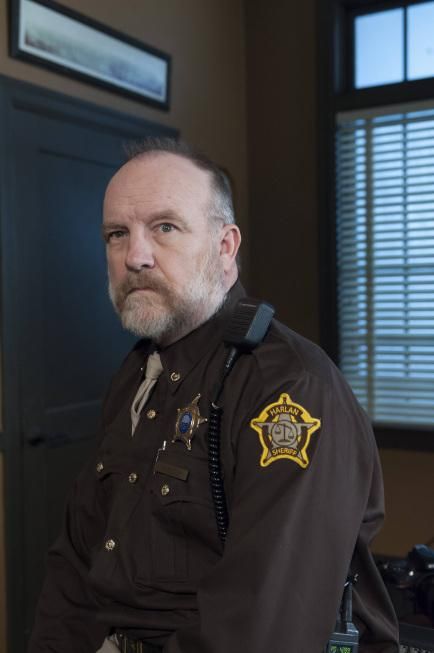


Parlow also later surprises the series' viewers when it's revealed that he is not who he appears to be. He is introduced as a security agent for the Black Pike Mining Company. He's saved by Boyd during a robbery. To gain control of Harlan County's sheriff's department, Boyd helps Shelby get elected as sheriff. After several other plot twists, it's revealed that Parlow has been living under an assumed identity. He's actually Drew Thompson, a former member of Detroit's Theo Tonin Crime Family. After witnessing Tonin murder someone, Thompson relocated to Harlan, Kentucky, where he started a new life under the name of Shelby Parlow. 

Justified isn't a horror series, of course, but the types of plot twists and cliffhangers it introduces can be used in any genre, so, to make a novel or a short story suspenseful and unpredictable, these types of such devices, used judiciously and with finesse, are recommended:
  • difficult situation
  • quandary
  • discovery
  • revelation
  • double-cross
  • triple-cross
  • setup
  • death (often as the result of a murder) of a character
  • rescue
  • assumed identity


Other television series also suggest a variety of types of plot twists and cliffhangers. Arrow has a multitude, as do most others. By analyzing the episodes in these series, you can compile a long list of types of situations and actions with which to surprise, shock, and intrigue readers while you maintain and heighten your story's suspense. To get you started, here are a few examples from several television series and other works of fiction; there are plenty of others:


Type
Setup
Twist
Death follows survival of death
Arrow: Oliver Queen's father survives a shipwreck.
He commits suicide.
Survival of death or apparent death
Sherlock Holmes: Sherlock Holmes falls from the edge of a cliff.
Holmes survives.

Buffy the Vampire Slayer: Buffy Summers drowns.
Buffy is revived by Xander, who administers mouth-to-mouth resuscitation.

Buffy the Vampire Slayer: Buffy Summers is killed.
Willow Rosenberg uses witchcraft to return Buffy to life.

Arrow: Sara Lance is presumed dead in same shipwreck.
She was rescued and trained by the League of Assassins.

Arrow: Thea Queen kills Sara Lance (Black Canary).
Sara is brought back to life by the Lazarus Pit.
Secret, false, or mistaken identity (anagnorisis)
Arrow: Oliver Queen's father is not Thea's father.
Malcolm Merlyn is Thea's father.

Arrow: Oliver Queen is not Thea's full brother.
They are half-siblings.
Murder of a recurring character
Arrow: Oliver Queen's mother is a recurring character.
Oliver's mother is murdered.
Murder of a recurring character (continued)
Arrow: Laurel Lance is a recurring character.
Damien Darhk kills Laurel.
Star-crossed lovers meet their doom
Romeo and Juliet: Romeo and Juliet love one another.
Romeo and Juliet commit suicide.

Buffy the Vampire Slayer: Buffy Summers falls in love with Angel, a vampire.
Angel leaves Buffy, moving away from Sunnydale.
A seemingly unbreakable rule is broken
Buffy the Vampire Slayer: There is only one Slayer in all the world.
Kendra Young appears after Buffy Summers's “momentary” death.

Buffy the Vampire Slayer: There is only one Slayer in all the world.
Faith LaHane appears after Kendra's death.
Reversal of fortune (peripeteia )
Buffy the Vampire Slayer: Cordelia Chase's father is wealthy.
Cordelia's father loses his fortune.
A character discovers a life-changing truth about him- or herself
Buffy the Vampire Slayer: Willow Rosenberg believes she is heterosexual.
Willow discovers she's a lesbian.
Readers discover a secret about a character
Buffy the Vampire Slayer: Oz seems to be a typical high school student.
Oz discovers he's a werewolf.

Buffy the Vampire Slayer: Joyce Summers's new boyfriend, Ted, seems a likable man.
Ted is a robot.

Buffy the Vampire Slayer: Rupert Giles is a sedate, responsible, mature mentor.
In his youth, Giles, then known as “Ripper,” was wild and violent and dabbled in witchcraft.
Readers discover a secret about a character (continued)
Buffy the Vampire Slayer: Sunnydale's germophobic mayor, Richard Wilkins, seems personable, if a bit wacky.
Wilkins is a demon.

Buffy the Vampire Slayer: Professor Maggie Walsh and her graduate assistant, Riley Finn, work at UC Sunnydale.
Walsh and Riley are both secret government agents.
Mistaken belief
Buffy the Vampire Slayer: A threat is believed to have been neutralized.
The threat reappears.
Chekov's gun: a seemingly minor character or plot element introduced early in the narrative that suddenly acquires great importance to the narrative.
A beggar woman appears at the beginning of Sweeney Todd.
The beggar woman is Todd's wife.


Monday, July 2, 2018

The Death of a Beautiful Woman

Copyright 2018 by Gary L. Pullman


Poe did write this, in his essay, “The Philosophy of Composition”—but what did he mean by it?


Some critics might contend that he was merely creating a pithy defense for “The Raven,” which concerns the speaker of the poem's grief for an unnamed woman who had died, a grief which has driven him insane with despair at the thought that he shall see her “nevermore.” If “the death . . . of a beautiful woman is, unquestionably, the most poetical topic in the world” and Poe's poem deals with this theme, obviously the work concerns the most elevated theme possible, which supports the idea that “The Raven” is itself likely to be one of the most poetic poems ever written.


In any case, horror movies and, quite often, novels frequently include the death of a beautiful woman. In fact, they often feature the deaths of any number of beautiful women. In horror movies, slashers, in particular, beautiful women are killed with abandon.


Some of the reasons for horror writers' bias in favor of female victims are fairly obvious. Typically, women are physically weaker than men and are, therefore, less able to defend themselves. Watching them as they are stalked by a suitably powerful, often grotesque and relentless, monster is likely to make viewers or readers who identify with them (and, yes, research shows that either sex is able to identify with its own or the opposite sex) feel that much more helpless.


Beautiful women do not always die, of course. Sometimes, they are rescued. According to evolutionary psychologists, men may be hard-wired, genetically, to risk their lives in the defense of beautiful damsels in distress, even when the men do not know the damsels personally; men are less likely, perhaps, to do the same for male strangers. Men's motives may not be entirely altruistic; often, in fiction, if not in “real life,” women reward heroes with more than just a thank you and a shake of the hand. Yes, such a subtext is sexist, but sexism, as such, doesn't necessarily make such a plot ineffective, as there is much tension in romance, regardless of its nature or source.


In addition to experiencing the terror of a damsel in distress, male audience members or readers can also vicariously enjoy the accolades and rewards of the victorious hero who rescues the distressed damsel. Most men don't get a chance to be a white knight in their everyday lives, or at least not in as dramatic a fashion as a horror story permits. Being allowed to experience the pride and self-esteem that such a role confers—as well as the rescued damsel's hand—is a perk hard to resist.


A female audience member or reader, on the other hand, can feel special. After all, her predicament—and her beauty—as represented by her stand-in, the story's beautiful damsel in distress, has caused a man to risk his life to save her. That's quite a testament to her charms! Then, should she care to express her gratitude in a “physical” fashion, she again demonstrates the power of her beauty by “conquering” the man who conquered the monster that tried to kill her. If the monster-slayer is powerful, how much more so is she, whose beauty conquers his strength. If he is Samson, she is Delilah.


The human species could survive with relatively few men, as long as there are a sufficiently large number of women. Theoretically, one man can impregnate millions upon millions of women over his lifetime. (In reality, in an extreme situation, he might actually impregnate a few thousand.) However, a woman can bear relatively few children before she is past her childbearing years. Each woman who is killed lessens the chance of the species' survival far more so than each man who is killed. For this reason, women symbolize life more frequently than men do; we speak of Mother Nature, after all, relegating men to the representation of mere Time. It makes more sense, from an evolutionary perspective, to rescue women (and children) before rescuing men. Therefore, we are likely to view as more horrible a woman's life at risk than we are to view a man's life at risk.


Today, male victims are increasingly shown, although there are still fewer of them than there are of female victims. Often, in fact, the last man standing (so to speak) isn't a male character at all, but the “final girl.” As originally conceived by Carol Clover, in her book Men, Women, andChainsaws: Gender in the Modern Horror Film (1992), the final girl was viewed “as a stereotype of the pure, virginal sole survivor in 1980’s slasher films such as TexasChainsaw Massacre and Halloween.” Sometimes, as in Backcountry, the male (Alex, in this case) is killed, despite his macho posturing, because of the poor judgments he makes, while the female (Jenn, in this instance) survives because of her greater maturity and common sense:

Alex's Errors in Judgment

Mistake
Type
Reason for Mistake
Consequence
Alex refuses ranger's offer of a park map. Judgment Alex's overconfidence; he seeks to impress Jenn with his woodcraft. Jenn and Alex become lost and have no guidance out of the woods. His behavior could endanger their lives.
Alex secretly leaves Jenn's cell phone in their car Judgment; deceit The lack of a prevents Jenn from communicating with others, focusing her attention on camping trip (and on Alex). Without a phone, Alex and Jenn have no way to call for help. His behavior could endanger their lives.
Alex leaves Jenn alone when he goes to chop wood. Judgment Unclear The stranger, Brad, who happens upon Jenn could be dangerous: he might have raped or killed Jenn. His behavior could endanger their lives.
Alex does not tell Jenn about the presence of a bear in the area. Judgment; deceit Alex wants their trip to continue. He hopes to impress Jenn with his woodcraft and intends to ask her to marry him. Jenn has bear spray and a traffic flare that they could use against the bear, but she is unaware of its presence. The bear could (and, later, does) kill someone. His behavior could endanger their lives.
Although he is uncertain of the correct path to the lake, Alex continues their trek through the forest. Judgment; deceit Alex wants their trip to continue. He hopes to impress Jenn with his woodcraft and intends to ask her to marry him. Alex and Jenn may be lost. His behavior could endanger their lives.
Alex does not leave the woods after seeing a bear print. Judgment Alex wants their trip to continue. He hopes to impress Jenn with his woodcraft and intends to ask her to marry him. Jenn has bear spray and a traffic flare that they could use against the bear, but she is unaware of its presence. The bear could (and, later, does) kill someone. His behavior could endanger their lives.
Without investigating, Alex tells Jenn sounds she hears are merely acorns falling from the trees, onto their tent. Judgment; possible deceit Alex wants their trip to continue. He hopes to impress Jenn with his woodcraft and intends to ask her to marry him. He may believe the sounds are the effects of falling acorns, as he says, or he may not want Jenn to think the sounds are caused by a bear, whether to keep her from being afraid or to prevent her from wanting to leave, in which case he is also being deceitful. Jenn has bear spray and a traffic flare that they could use against the bear, but she is unaware of its presence. The bear could (and, later, does) kill someone. His behavior could endanger their lives.
Even after hearing the sounds of what might be a bear, instead of falling acorns, Alex refuses to leave the park. Judgment Alex wants their trip to continue. He hopes to impress Jenn with his woodcraft and intends to ask her to marry him. His behavior could endanger their lives.
Even after seeing a broken tree branch indicative of a bear's nearby presence, Alex refuses to leave the park. Judgment Alex wants their trip to continue. He hopes to impress Jenn with his woodcraft and intends to ask her to marry him. His behavior could endanger their lives.
Even after seeing the carcass of a dead deer indicating the presence of a bear—and of a bear that is both starving (bears, otherwise, don't eat meat—and predatory)—Alex refuses to leave the park. Judgment Alex wants their trip to continue. He hopes to impress Jenn with his woodcraft and intends to ask her to marry him. His behavior could endanger their lives.
Even after the bear visits their campsite, Alex refuses to leave the park. Judgment Alex wants their trip to continue. He hopes to impress Jenn with his woodcraft and intends to ask her to marry him. His behavior could endanger their lives.
Alex leaves his axe outside the tent. Carelessness

With his axe inside the tent, Alex would have had a weapon with which to fight off the attacking bear; without it, he has nothing but his hands and feet. His behavior could endanger their lives.

Jenn's Errors in Judgment

Mistake
Type
Reason for Mistake
Consequence
Jenn did not insist that Alex accept a park map from the ranger or accept one herself.
Judgment
Jenn probably did not want to embarrass Alex by casting doubts on his knowledge of the park.
Alex and Jenn may be lost. Her behavior could endanger their lives.
In Alex's absence, Jenn invites Brad onto their campsite.
Judgment
Jenn is being friendly.
Since she does not know Brad, Jenn could be endangering her and Alex's lives and could be putting herself in danger of being raped.
Jenn does not insist that Alex make sure the “acorns” he says are falling on their tent really are acorns.
Judgment
Jenn probably did not want to embarrass Alex by casting doubts on his knowledge of the park.
Her behavior could endanger their lives.
Jenn does not insist that Alex take her home after she sees evidence of the nearby presence of a bear.
Judgment
Jenn allows Alex to persuade her to stay because she has feelings for him and may feel sorry for him.
Her behavior could endanger their lives.
Jenn returns to their campsite after the bear has killed Alex so she can retrieve the engagement ring he has shown her.
Judgment
Jenn, who had feelings for Alex, wants a memento of his love for her.
Her behavior could endanger her life. lives.

Note: Although Jenn, like Alex, makes mistakes in judgment, she is not a woodman and the couple's survival is not primarily her responsibility. In addition, she is not deceitful toward Alex, as he is to her. When she is alone, after Alex's death, her decisions are wise, allowing her to survive the bear and the wilderness.


Female characters have come a long way since the days of King Kong's Ann Darrow. Today, many are as kick-ass as Buffy the VampireSlayer. Pity the poor monster that attacks one of these “damsels in distress.”

Paranormal vs. Supernatural: What’s the Diff?

Copyright 2009 by Gary L. Pullman

Sometimes, in demonstrating how to brainstorm about an essay topic, selecting horror movies, I ask students to name the titles of as many such movies as spring to mind (seldom a difficult feat for them, as the genre remains quite popular among young adults). Then, I ask them to identify the monster, or threat--the antagonist, to use the proper terminology--that appears in each of the films they have named. Again, this is usually a quick and easy task. Finally, I ask them to group the films’ adversaries into one of three possible categories: natural, paranormal, or supernatural. This is where the fun begins.

It’s a simple enough matter, usually, to identify the threats which fall under the “natural” label, especially after I supply my students with the scientific definition of “nature”: everything that exists as either matter or energy (which are, of course, the same thing, in different forms--in other words, the universe itself. The supernatural is anything which falls outside, or is beyond, the universe: God, angels, demons, and the like, if they exist. Mad scientists, mutant cannibals (and just plain cannibals), serial killers, and such are examples of natural threats. So far, so simple.

What about borderline creatures, though? Are vampires, werewolves, and zombies, for example, natural or supernatural? And what about Freddy Krueger? In fact, what does the word “paranormal” mean, anyway? If the universe is nature and anything outside or beyond the universe is supernatural, where does the paranormal fit into the scheme of things?

According to the Online Etymology Dictionary, the word “paranormal,” formed of the prefix “para,” meaning alongside, and “normal,” meaning “conforming to common standards, usual,” was coined in 1920. The American Heritage Dictionary defines “paranormal” to mean “beyond the range of normal experience or scientific explanation.” In other words, the paranormal is not supernatural--it is not outside or beyond the universe; it is natural, but, at the present, at least, inexplicable, which is to say that science cannot yet explain its nature. The same dictionary offers, as examples of paranormal phenomena, telepathy and “a medium’s paranormal powers.”

Wikipedia offers a few other examples of such phenomena or of paranormal sciences, including the percentages of the American population which, according to a Gallup poll, believes in each phenomenon, shown here in parentheses: psychic or spiritual healing (54), extrasensory perception (ESP) (50), ghosts (42), demons (41), extraterrestrials (33), clairvoyance and prophecy (32), communication with the dead (28), astrology (28), witchcraft (26), reincarnation (25), and channeling (15); 36 percent believe in telepathy.

As can be seen from this list, which includes demons, ghosts, and witches along with psychics and extraterrestrials, there is a confusion as to which phenomena and which individuals belong to the paranormal and which belong to the supernatural categories. This confusion, I believe, results from the scientism of our age, which makes it fashionable for people who fancy themselves intelligent and educated to dismiss whatever cannot be explained scientifically or, if such phenomena cannot be entirely rejected, to classify them as as-yet inexplicable natural phenomena. That way, the existence of a supernatural realm need not be admitted or even entertained. Scientists tend to be materialists, believing that the real consists only of the twofold unity of matter and energy, not dualists who believe that there is both the material (matter and energy) and the spiritual, or supernatural. If so, everything that was once regarded as having been supernatural will be regarded (if it cannot be dismissed) as paranormal and, maybe, if and when it is explained by science, as natural. Indeed, Sigmund Freud sought to explain even God as but a natural--and in Freud’s opinion, an obsolete--phenomenon.

Meanwhile, among skeptics, there is an ongoing campaign to eliminate the paranormal by explaining them as products of ignorance, misunderstanding, or deceit. Ridicule is also a tactic that skeptics sometimes employ in this campaign. For example, The Skeptics’ Dictionary contends that the perception of some “events” as being of a paranormal nature may be attributed to “ignorance or magical thinking.” The dictionary is equally suspicious of each individual phenomenon or “paranormal science” as well. Concerning psychics’ alleged ability to discern future events, for example, The Skeptic’s Dictionary quotes Jay Leno (“How come you never see a headline like 'Psychic Wins Lottery'?”), following with a number of similar observations:

Psychics don't rely on psychics to warn them of impending disasters. Psychics don't predict their own deaths or diseases. They go to the dentist like the rest of us. They're as surprised and disturbed as the rest of us when they have to call a plumber or an electrician to fix some defect at home. Their planes are delayed without their being able to anticipate the delays. If they want to know something about Abraham Lincoln, they go to the library; they don't try to talk to Abe's spirit. In short, psychics live by the known laws of nature except when they are playing the psychic game with people.
In An Encyclopedia of Claims, Frauds, and Hoaxes of the Occult and Supernatural, James Randi, a magician who exercises a skeptical attitude toward all things alleged to be paranormal or supernatural, takes issue with the notion of such phenomena as well, often employing the same arguments and rhetorical strategies as The Skeptic’s Dictionary.

In short, the difference between the paranormal and the supernatural lies in whether one is a materialist, believing in only the existence of matter and energy, or a dualist, believing in the existence of both matter and energy and spirit. If one maintains a belief in the reality of the spiritual, he or she will classify such entities as angels, demons, ghosts, gods, vampires, and other threats of a spiritual nature as supernatural, rather than paranormal, phenomena. He or she may also include witches (because, although they are human, they are empowered by the devil, who is himself a supernatural entity) and other natural threats that are energized, so to speak, by a power that transcends nature and is, as such, outside or beyond the universe. Otherwise, one is likely to reject the supernatural as a category altogether, identifying every inexplicable phenomenon as paranormal, whether it is dark matter or a teenage werewolf. Indeed, some scientists dedicate at least part of their time to debunking allegedly paranormal phenomena, explaining what natural conditions or processes may explain them, as the author of The Serpent and the Rainbow explains the creation of zombies by voodoo priests.

Based upon my recent reading of Tzvetan Todorov's The Fantastic: A Structural Approach to the Fantastic, I add the following addendum to this essay.

According to Todorov:

The fantastic. . . lasts only as long as a certain hesitation [in deciding] whether or not what they [the reader and the protagonist] perceive derives from "reality" as it exists in the common opinion. . . . If he [the reader] decides that the laws of reality remain intact and permit an explanation of the phenomena described, we can say that the work belongs to the another genre [than the fantastic]: the uncanny. If, on the contrary, he decides that new laws of nature must be entertained to account for the phenomena, we enter the genre of the marvelous (The Fantastic: A Structural Approach to a Literary Genre, 41).
Todorov further differentiates these two categories by characterizing the uncanny as “the supernatural explained” and the marvelous as “the supernatural accepted” (41-42).

Interestingly, the prejudice against even the possibility of the supernatural’s existence which is implicit in the designation of natural versus paranormal phenomena, which excludes any consideration of the supernatural, suggests that there are no marvelous phenomena; instead, there can be only the uncanny. Consequently, for those who subscribe to this view, the fantastic itself no longer exists in this scheme, for the fantastic depends, as Todorov points out, upon the tension of indecision concerning to which category an incident belongs, the natural or the supernatural. The paranormal is understood, by those who posit it, in lieu of the supernatural, as the natural as yet unexplained.

And now, back to a fate worse than death: grading students’ papers.

My Cup of Blood

Anyone who becomes an aficionado of anything tends, eventually, to develop criteria for elements or features of the person, place, or thing of whom or which he or she has become enamored. Horror fiction--admittedly not everyone’s cuppa blood--is no different (okay, maybe it’s a little different): it, too, appeals to different fans, each for reasons of his or her own. Of course, in general, book reviews, the flyleaves of novels, and movie trailers suggest what many, maybe even most, readers of a particular type of fiction enjoy, but, right here, right now, I’m talking more specifically--one might say, even more eccentrically. In other words, I’m talking what I happen to like, without assuming (assuming makes an “ass” of “u” and “me”) that you also like the same. It’s entirely possible that you will; on the other hand, it’s entirely likely that you won’t.

Anyway, this is what I happen to like in horror fiction:

Small-town settings in which I get to know the townspeople, both the good, the bad, and the ugly. For this reason alone, I’m a sucker for most of Stephen King’s novels. Most of them, from 'Salem's Lot to Under the Dome, are set in small towns that are peopled by the good, the bad, and the ugly. Part of the appeal here, granted, is the sense of community that such settings entail.

Isolated settings, such as caves, desert wastelands, islands, mountaintops, space, swamps, where characters are cut off from civilization and culture and must survive and thrive or die on their own, without assistance, by their wits and other personal resources. Many are the examples of such novels and screenplays, but Alien, The Shining, The Descent, Desperation, and The Island of Dr. Moreau, are some of the ones that come readily to mind.

Total institutions as settings. Camps, hospitals, military installations, nursing homes, prisons, resorts, spaceships, and other worlds unto themselves are examples of such settings, and Sleepaway Camp, Coma, The Green Mile, and Aliens are some of the novels or films that take place in such settings.

Anecdotal scenes--in other words, short scenes that showcase a character--usually, an unusual, even eccentric, character. Both Dean Koontz and the dynamic duo, Douglas Preston and Lincoln Child, excel at this, so I keep reading their series (although Koontz’s canine companions frequently--indeed, almost always--annoy, as does his relentless optimism).

Atmosphere, mood, and tone. Here, King is king, but so is Bentley Little. In the use of description to terrorize and horrify, both are masters of the craft.

Believable characters. Stephen King, Douglas Preston and Lincoln Child, and Dan Simmons are great at creating characters that stick to readers’ ribs.

Innovation. Bram Stoker demonstrates it, especially in his short story “Dracula’s Guest,” as does H. P. Lovecraft, Edgar Allan Poe, Shirley Jackson, and a host of other, mostly classical, horror novelists and short story writers. For an example, check out my post on Stoker’s story, which is a real stoker, to be sure. Stephen King shows innovation, too, in ‘Salem’s Lot, The Shining, It, and other novels. One might even argue that Dean Koontz’s something-for-everyone, cross-genre writing is innovative; he seems to have been one of the first, if not the first, to pen such tales.

Technique. Check out Frank Peretti’s use of maps and his allusions to the senses in Monster; my post on this very topic is worth a look, if I do say so myself, which, of course, I do. Opening chapters that accomplish a multitude of narrative purposes (not usually all at once, but successively) are attractive, too, and Douglas Preston and Lincoln Child are as good as anyone, and better than many, at this art.

A connective universe--a mythos, if you will, such as both H. P. Lovecraft and Stephen King, and, to a lesser extent, Dean Koontz, Bentley Little, and even Douglas Preston and Lincoln Child have created through the use of recurring settings, characters, themes, and other elements of fiction.

A lack of pretentiousness. Dean Koontz has it, as do Douglas Preston and Lincoln Child, Bentley Little, and (to some extent, although he has become condescending and self-indulgent of late, Stephen King); unfortunately, both Dan Simmons and Robert McCammon have become too self-important in their later works, Simmons almost to the point of becoming unreadable. Come on, people, you’re writing about monsters--you should be humble.

Longevity. Writers who have been around for a while usually get better, Stephen King, Dan Simmons, and Robert McCammon excepted.

Pacing. Neither too fast nor too slow. Dean Koontz is good, maybe the best, here, of contemporary horror writers.