Saturday, August 17, 2019

Scientist Turned Ghostbuster (and Vampirebuster)

Copyright 2019 by Gary L. Pullman


Are you afraid of vampires?

Do you sleep with a cross or a crucifix around your neck?

Does your house (and your breath) smell like garlic?

Do you keep a bottle of holy water on hand?

Are you careful to be home by dark every day?

Could an unsuspecting guest stumble upon a few wooden stakes and a mallet stashed in your dresser?

If so, you need not fear bloodsucking dead people any longer!

A scientist has come to the rescue with a mathematical proof against the possibility of the existence of vampires!


University of Central Florida physics professor Costas Efthimiou starts with the human population on January 1, 1600, which was 536,870,911. On this day, the first vampire appears and bites one person each month. On the first day of February, there are two bloodsucking freaks. On March 1, 1600, there are four vampires. In 2.5 years, there are no more humans to feed on, because everyone on the planet has been turned into a vampire! There's no food left for the bloodsuckers, so they die of starvation. (On the downside, there are no more people, either.)

Not even doubling the human birthrate (if such a gambit were possible) could save the human species, Dr. Efthimiou says: “In the long run, humans cannot survive under these conditions, even if our population were doubling each month. And doubling is clearly way beyond the human capacity of reproduction.”

So, there you have it, thanks to Professor Efthimiou: there's no need to fear the existence of vampires. If there were, both vampires and humans would have disappeared in mid-1603. Since we humans, at least, are still here, there obviously are no such things as vampires.


For some folks, ghosts are scary phenomena, too, but there's no need to worry about these spectral beings, either, another scientist says.


Dr. Brian Cox, a physicist, has proved there aren't any ghosts, either. If they did exist, they'd be entities of pure energy, since, by definition, they're incorporeal. According to the second law of thermodynamics, energy is always “lost to heat”; therefore, ghosts, as beings of pure energy, would soon drift apart and cease to exist. 
 

Friday, August 16, 2019

Plotting by Poster, Part II

Copyright 2019 by Gary L. Pullman

In case you missed the initial post concerning this topic, I suggested how movie posters can help to suggest plots and identified these guidelines for anyone who might like to try this approach to plotting stories:

  1. If the poster you select promotes a movie you have seen, pretend it does not, and don't reference the film, even in your thoughts, as you analyze the poster. The poster should speak for itself, as it were.
  2. We are taught to read from left to right and from top to bottom. Graphic designers know this and use our training to their benefit in creating designs and art and in communicating to us.
  3. A poster is likely to have a central image, and this central image will be emphasized in some way—through its position, just off center; through color or intensity; by being of bigger than other images. It is obvious that the artist wants the viewer to focus attention on this central image. Text and other images, if any, will relate to this central image and help to develop its figurative aspects.
  4. Most art employs various “visual” figures of speech—metaphors, similes, allusions, personifications, exaggerations, understatements, symbols, puns or other plays on words, synecdoches.
  5. See all there is to see—not just size, but color, intensity, depth, balance, negative and positive space, shape, texture, size, density, position, arrangement, patterns. facial expressions, hairstyles, costumes (i. e., the models' clothing), age, sex, gender, class, income level. Also consider whatever props might be displayed.
  6. Analyze visual evidence of behavior: care, neglect, attendance, abandonment, support, and so forth.
  7. Consider the other four senses, too: what sounds, tastes, smells, and tactile sensations does the poster suggest?
  8. The text is the key that unlocks the visual imagery's figurative meaning.

With these guidelines in mind, start by describing the poster. Start at the top and work your way down. Include quotations of any text you encounter. Be detailed, but don't be flowery. At this point, be a camera operator, not a sketch artist, an objective viewer, not an interpreter.

After describing the poster, use the elements you identified to complete this table. In doing so, stick to the poster itself.

WHO?
WHAT?
WHEN?
WHERE?
HOW?
WHY?

Next, question yourself about each of the six phrases you entered into the table. In doing so, make observations; draw inferences from what you see and read in the poster. Look for potential relationships among the poster's elements. Look, also, for possible connections between your own thoughts, between your own feelings, and between your own thoughts and feelings. Ask yourself how the answers you listed in the table could be “flipped,” or reinterpreted.

As a result of this process, you may develop an idea for a story or even a synopsis of a plot for a story. At the same time, you will have a sequence of elements that are logically related and which, together, form a narrative thread upon which, by the questioning process and the use of your own imagination, you can embroider, or develop further. Statues of saints stand on pedestals connected to the same walls, farther along.

THE OFFERING


Text above the image reads, in blood-red letters: “The chosen will be sacrificed.”

Hanging, apparently from the ceiling of the cathedral in which their suspended bodies hang, visible from the knee down, are three corpses. They wear slips, skirts, or dresses, which suggest that the bodies of those of women. Blood trails along the wall on either side of the bodies.

The title of the film, The Offering, appears across the middle of the image, diving it into an upper and a lower half. The bodies of the women and the cathedral's ceiling and walls occupy the upper half of the poster. Below the title, the statues, blood-smeared pews, and a bloody cross appear. The blood trailing down the walls link the upper and the lower halves of the poster. The aisle between the ranks of pews is saturated with blood.

Observations

The women's legs seem to be lacerated; they have bled. They also appear to be scarred. Although they may wear skirts or dresses, it's also possible that they wear only slips. Although their legs have bled, they have not done so profusely, but the volume of blood in the cathedral—on its walls, pews, and aisle—indicate extreme blood loss. Even if the women bear wounds in their abdomens, it is unlikely that three of them could have shed as much blood as stains the cathedral.

The cross is neither the Latin cross of Protestant denominations nor the Catholic crucifix, but a Levithan cross (also known as the brimstone symbol, Satan's cross, the cross of Lorraine, and the Patriarchal cross). In some cases, the crossbeams (arms) of the cross are of different lengths, with the top arm shown as being shorter than the lower arm, but the crossbeams are also shown as being of equal lengths. The cross has various mystical meanings and associations.

WHO? The corpses of three bloody, scarred women
WHAT? hang
WHEN? during the day
WHERE? from a cathedral ceiling
HOW? by unknown means
WHY? sacrifices of a diabolical cult.

Result: The corpses of three bloody, scarred women hang, during the day, from a cathedral ceiling by unknown means, sacrifices of a diabolical cult.

Questions

Why and by whom were these three women in particular “chosen”? Did they “sin” against the tenets of their “faith”? Are their deaths meant to appease an angry deity or spirit? If so, how and why? If not, what is the purpose of their sacrifices? Who benefits from their sacrifices and how? Have they been left hanging so the blood would drain from their bodies or as a warning to other congregants? Were the women sexually assaulted before they were killed? Were they beaten or tortured? What caused their deaths? Why are the women's upper bodies not shown? How did blood get on the walls, pews, aisle, and Leviathan cross? How did blood from the Leviathan cross form two other crosses (or did this blood form the capital letter “H”)? Is the cathedral, a center and a symbol of Christian faith—and a house of God—being mocked? If so, by whom and for what reason? How can the story line be “flipped”?

SLITHER


Centered at the top of the poster, against a shadow in the form of a cross (the frame of a window), the shaved, bent right leg of a young woman appears above the side of a white porcelain bathtub located next to a tile wall; the bathtub is half filled with soapy water.

The scene is framed by the left jamb of a doorway and by the open door to the bathroom. On the edge of the bathtub, a red creature resembling a cross between a snail and a gigantic sperm cell perches, as a second creature follows it, through its trail of slime, leaving a trail of slime behind itself as well.

Below the second creature, a third lifts its body and appears to attach its head to the side of the tub, preparing to follow the other two creatures up the side of the tub. At least eighteen more of the creatures gather on the floor, near the tub.

Observations

The shadow could suggest that the story has religious significance or religious undertones. The cross formed by the shadow is Latin in design, suggesting a Protestant denomination. The fact that it is merely the a shadow could imply that the young woman's faith is insubstantial.

The door is open, although one would expect it to be closed, since the woman is bathing.

The creatures resemble gigantic sperm cells in shape, but they are meaty, red, and “raw” looking, both meat (phalli, perhaps) and sperm. Their appearance is disgusting, and it, like the number of the creatures, seems menacing. They seem intent upon attacking the young woman, as if they are parasites in search of a host. They are large, too, if they are intended to represent phalli. Long and thick, they might cause pain. Despite their sperm-like appearance, none of the creatures exhibits testicles, which makes them perverse as well as disgusting. The slime they rail behind them resembles semen, but, considering that the slime is behind them, it wouldn't be fecundating fluid, unless the creatures exude more of it during their assault. (The number of the creatures suggests gang rape.)

The film's title, Slither, emphasizes the method of locomotion the creatures employ, which is one shared by snakes, a smooth movement “over a surface with a twisting or oscillating motion.” The verb's synonyms suggest additional associations, “squirm,” “wriggle,” “snake,” and “worm,” which, in turn, suggest such qualities as furtiveness and evil (like “dragon,” “worm” and “snake” were associated with the devil).

In religious ritual, bathing is a means of cleansing one's soul, of washing away sins. The young woman's nudity suggests there may be a relationship between it and the devil, that her body has been an instrument of fornication, a sin against God, and that she now seeks to cleanse herself spiritually, albeit in vain, since the slug-like creatures resembling sperm cells have invaded her home, her bathroom, and appear to be about to invade her body as well.

The open door reveals a private act—the cleansing of the soul—making a personal and spiritual action a public spectacle. Despite the woman's attempt to gain absolution, the poster seems to suggest that her sins will be revealed and she must suffer for her indiscretion.
WHO: A naked young woman
WHAT: is about to be assaulted by bizarre creatures
WHEN: as she bathes
WHERE: in a bathtub in her bathroom
HOW: with soap and water
WHY: to cleanse herself and her soul after having had sex.

Questions

Is the young woman devoted in her religious faith? Why is only her leg shown? Why is the door to the bathroom open instead of closed while she bathes? Who opened the door? She? Someone else? The creatures? (Was the door locked or only closed?) What are the strange creatures? What are their abilities? Why are there so many of them? What led to their bizarre appearance? Why are they attracted to the young woman? Are they a menace to her? How could the story line be “flipped”?

Like to try the approach yourself? Here's a poster to get you started:


Thursday, August 15, 2019

Plotting by Poster

Copyright 2019 by Gary L. Pullman

In this post, I would like to suggest how movie posters can help to suggest plots. Before I get to a couple of examples, though, I offer a few guidelines for anyone who might like to try this approach to plotting stories. They have served me well.
  1. If the poster you select promotes a movie you have seen, pretend it does not, and don't reference the film, even in your thoughts, as you analyze the poster. The poster should speak for itself, as it were.
  2. We are taught to read from left to right and from top to bottom. Graphic designers know this and use our training to their benefit in creating designs and art and in communicating to us.
  3. A poster is likely to have a central image, and this central image will be emphasized in some way—through its position, just off center; through color or intensity; by being of bigger than other images. It is obvious that the artist wants the viewer to focus attention on this central image. Text and other images, if any, will relate to this central image and help to develop its figurative aspects.
  4. Most art employs various “visual” figures of speech—metaphors, similes, allusions, personifications, exaggerations, understatements, symbols, puns or other plays on words, synecdoches.
  5. See all there is to see—not just size, but color, intensity, depth, balance, negative and positive space, shape, texture, size, density, position, arrangement, patterns. facial expressions, hairstyles, costumes (i. e., the models' clothing), age, sex, gender, class, income level. Also consider whatever props might be displayed.
  6. Analyze visual evidence of behavior: care, neglect, attendance, abandonment, support, and so forth.
  7. Consider the other four senses, too: what sounds, tastes, smells, and tactile sensations does the poster suggest?
  8. The text is the key that unlocks the visual imagery's figurative meaning.
With these guidelines in mind, start by describing the poster. Start at the top and work your way down. Include quotations of any text you encounter. Be detailed, but don't be flowery. At this point, be a camera operator, not a sketch artist, an objective viewer, not an interpreter.

After describing the poster, use the elements you identified to complete this list, creating a complete sentence in the process. In doing so, stick to the poster itself.


WHO?
WHAT?
WHEN?
WHERE?
HOW?
WHY?


Next, question yourself about each of the six phrases you entered into the table. In doing so, make observations; draw inferences from what you see and read in the poster. Look for potential relationships among the poster's elements. Look, also, for possible connections between your own thoughts, between your own feelings, and between your own thoughts and feelings. Ask yourself how the answers you listed in the table could be “flipped,” or reinterpreted.

As a result of this process, you may develop an idea for a story or even a synopsis of a plot for a story. At the same time, you will have a sequence of elements that are logically related and which, together, form a narrative thread upon which, by the questioning process and the use of your own imagination, you can embroider, or develop further.

FRIGHT NIGHT


Text above the image reads: “There are some very good reasons to be afraid of the dark.”

It is night. There are stars and a full moon. Spirits swarm above a house. One appears to be the ghost of a vampire; its wide open mouth is positioned above the center of the house, near the domicile's rooftops. Two other spirits have a bestial appearance. The rest are heads with faces and fanged mouths—demons, perhaps.

Behind a simple white rails, a front porch runs the length of the three-story Victorian house. In the center, second-floor room (perhaps a bedroom), the silhouette of a standing figure, hands on hips, is visible between drawn drapes, against light.

Five low steps lead to the porch from the end of a sidewalk, the other end of which connects to a sidewalk that parallels the street out front. Low shrubs are planted along the front of the porch. A tree flanks each side of the front of the house; each is almost as tall as the house. The lawn is cut. Behind the house is a line of trees, perhaps the front rank of a forest.

Text below the image reads, “Fright Night: If you love being scared, it'll be the night of your life.”

Observations

Although the house could be in a suburbs, it seems more likely that it is in a more rural area. Not only are there large trees present, but the visibility of the stars suggests that the house is some distance from the street lights common to suburbs.

The swarm of spirits seem to fountain from the house, suggesting that it is haunted.

Although rather indistinct, the figure appears to be wearing a dress, which would indicate that the figure is that of a woman. It is impossible to tell whether she faces forward, but her presence at the window suggests that she is looking out of the room.

The house is in good repair, and the lawn is landscaped and well kept.

The text suggests that this is a special night; it is Fright Night. The text also suggests that the spirits are the “reasons” that one should fear the dark.

The text that reads “it'll be the night of your life” suggests that Fright Night will be momentous, probably unique.

The figure stands in a lighted room, surrounded by darkness. The room may be her “safe place,” but only as long as the light continues to burn.

WHO? A young woman
WHAT? stands watch
WHEN? at night
WHERE? in the lighted room of an otherwise dark Victorian house in a rural part of the United States
HOW? ready to become a conduit for spiritual warriors
WHY? to ward off a horde of demons that appear every decade on Fright Night.

Questions

Over what, if anything, do the demons rule? What powers do they have? Why do they appear every decade on Fright Night? Whom do they seek to frighten? Why is one the spirit of a vampire? Why are two of bestial form? Why do the remaining demons look similar? Where are the spirits' bodies? Why have they gathered here, at this particular house? Is the house significant in some way? Who is the young woman? Why is she in the house? Why is she alone? How can the story line be flipped?

IT FOLLOWS


Text above the image reads, “it doesn't think. It doesn't feel. It doesn't give up.”

Looking frightened, a tense, young blonde woman, eyes wide, stares into her car's rear-view mirror, which she adjusts. Outside, it is dark and perhaps foggy. Her headlights don't seem to penetrate the gloom.

Text below the image, the film's title, reads, “It Follows.”

Observations

The woman wears makeup, and her nails are painted red-orange. Her eyebrows, like her eyes, are brown, which suggests that she is a peroxide, not a natural, blonde. She wears her hair in a bob or a pixie cut.

WHO? A young woman
WHAT? looks into her rear-view mirror
WHEN? at night
WHERE? on a lonely stretch of country road
HOW? as she is driving her car
WHY? fleeing from a relentless, inhuman pursuer.
 
Questions

Who is the young woman? She appears to be alone—is she? If so, why? If not, why not? Where is she going? Where has she been? Is she on some sort of mission or is she just trying to escape? Why is she driving at night? Who or what is she fleeing? Why is her pursuer chasing her? Why is her pursuer relentless? Is her pursuer behind her, as she appears to believe, or in front of her? Her tension and fear suggest she may be involved in an emergency situation? Is she? If so, what is the emergency? If not, what else explains her tension and fear? Is her car a sedan? A convertible? New? An older model? How large or small is her car? Is it in good repair? Is someone expecting her? If so, who? Why? If not, why not?

In future posts, I may model this technique for plotting by posters again. There are many posters, after all—an inexhaustible supply of them. To generate a strong, intriguing, suspenseful plot, we need only one. Meanwhile, why not try your own hand at this poster:


Tuesday, August 13, 2019

Telling Images: Horror Movie Poster Tropes

Copyright 2019 by Gary L. Pullman

Although they are not to everyone's taste, perhaps, horror movie posters are works of art.

To promote their films, such posters use a variety of visual and linguistic techniques. The latter often include the movie's title, a caption, a pun or another type of play on words, an allusion, a symbol, or a metaphor. The former exclude almost nothing.

Today's post focuses on horror movie posters' use of body parts. Specifically, we're concerned with eyes, mouths, breasts, buttocks, hands, and female genitals. (Ears, noses, feet, and phalli don't appear to play much, if any, part in horror movie poster art.)

Perhaps, in a future post, we'll consider heads (decapitated, of course), arms and legs (dismembered, naturally), and internal organs (eviscerated, obviously).

Let's start at the top and work our way down.

The Eyes Have It

Eyes are featured in quite a few horror movie posters.


Such posters feature wide eyes suggestive of shock or terror; reptilian eyes with slit pupils (Beneath Loch Ness); the whites of eyes, sans irises (The Return); and an eye in which fire (and a fiery cross) burns (The Visitation).


In some such posters, eyes are replaced with such substitutes as screaming mouths (One Missed Call), hands (Oculus), and treetops (Cabin Fever).


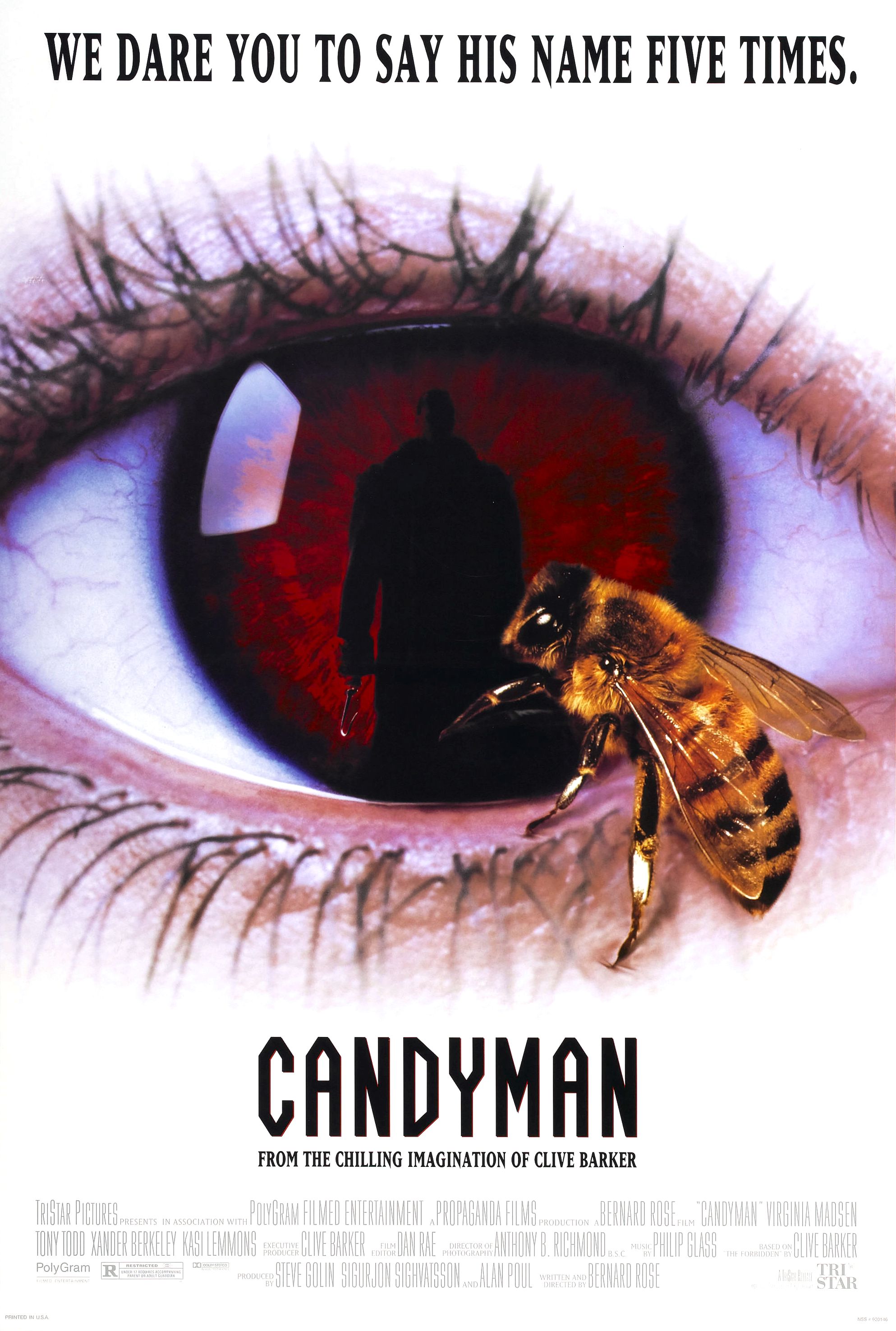
Live creatures or objects exit some eyes: a hand (The Eye) and blood (The Eye). In other images, something enters the eye or is about to do so: the edge of a single-edge razor blade (Would You Rather?) and a yellow jacket (Candyman).


Eyes are displaced (relocated) to incongruous sites in still other horror movie posters (one peeks out between the lips of a mouth in the poster for The Theater Bizarre, or are equipped with the body parts of another species (a gigantic eye becomes a tentacled monster in the poster promoting The Crawling Eye).


As mirrors, eyes reflect the threat or a victim that a character (perhaps him- or herself a potential victim) sees, thus allowing the audience a glimpse at the menace as well: Hipnoz, The Texas Chainsaw Massacre, The Eye, The Skeleton Key.


Five-pointed stars, or pentagrams, are carved into the case of a victim in the Starry Eyes movie poster—right over her eyes.

There are as many ways to include images of eyes in horror movie posters as there are ways to imagine such use, but such devices as spotlighting, substitution, the egress and ingress of foreign objects, displacement, reflection, and mutilation are certainly some of the horrific techniques that make the eyes emblems of fear, especially in movies that feature body horror.

Getting Mouthy


A straight-jacketed corpse is shows inside a screaming mouth (In the Mouth of Madness). Bestial lips frame drooling teeth and fangs in The Funhouse movie poster. At the end of a bent wrist, a hand claws its way through a gaping mouth in the poster for The Possession. A girl's mouth is missing in Silent Hill's poster, and a woman's mouth is obstructed by a locked metal band in another of Silent Scream's posters.

Like eyes, which provide the capability of sight, mouths are useful to our survival. They help us to eat and to communicate; they also allow us to sound the alarm, to scream—unless they are missing or muffled with a gag.

Keeping Abreast of Things

Most horror movie posters eschew nudity. Instead, breasts, buttocks, and genitals are partially revealed (and, thus, partially concealed). Nevertheless, an emphasis on them, whether as a result of partial nudity or otherwise, makes them the center of attention in the poster and in the viewers' perceptions.


Bikinis are revealing, and their brief tops expose quite a bit of cleavage in Blood Night's poster—so much so that viewers, especially males, might not see the hatchet in her right hand and the decapitated man's head that she holds by its hair in her right hand as she trudges through a forest of leafless trees.


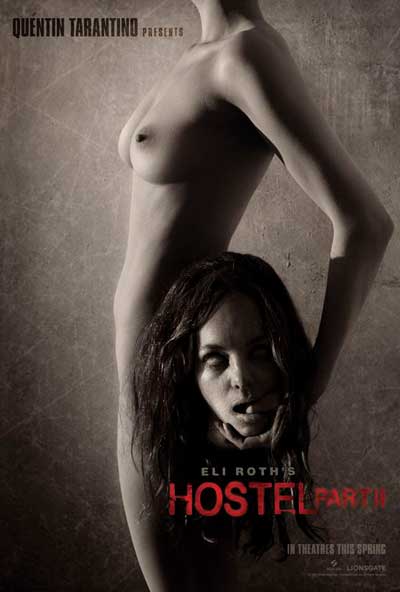
A rare pair of bare breasts do appear in the poster for Hostel II''s poster, but they aren't enough to deflect attention from the decapitated head the topless woman holds, which is, perhaps, her own: she is not shown above the neck.


The Machete Kills poster displays one of the more creative uses of breasts. The woman it features (actress Sophia Vergara as Desdemona) has twin machine guns strapped to her chest, the domes from which the firing barrels protrude covering her breasts.

A number of other horror movie posters feature breasts. Apart from those in the Machete Kills poster, though, most of these particular body parts, ironically enough, seem to have the purpose of either attracting attention to themselves or of deflecting attention away from something or someone else b, well, drawing attention to themselves.

Bottoms Up

Sexologist Alfred Kinsey suggests that women's buttocks, not their beasts, are mainly what attract the male of the species, and some social scientists claim that men's obsession with breasts stems from the resemblance of breasts to buttocks. Be that as it may, more horror movie posters seem to feature breasts than buttocks.

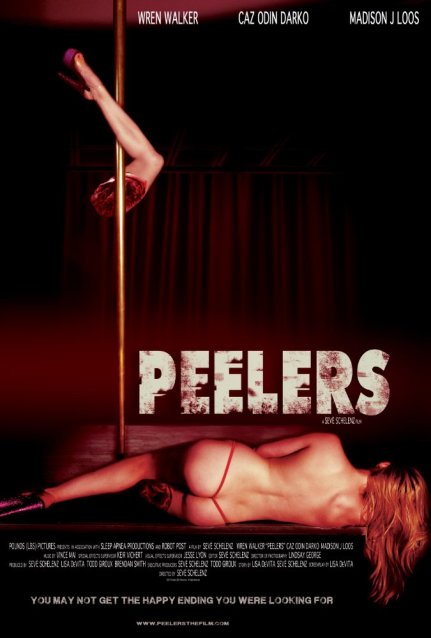
Still, such posters do present posteriors as well. The poster for Peelers, which shows a woman in high heels and thong panties lying on her right side, facing forward, away from the viewer, is an example. So arresting is the image that many might not see her severed leg hanging from the pole she was apparently dancing around (or hanging from) before she lost her gam. If so, it would seem that the buttocks, in this poster, serves the same purpose that the bare breasts exhibited in the Hostel II poster fulfills, diverting viewers' attention from the horrific image of the severed leg by focusing their attention, initially, at least, on the erotic image of the woman's naked bottom.


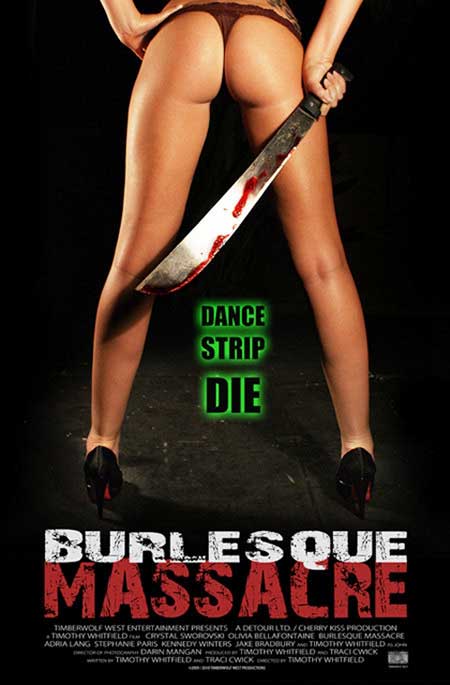
Burlesque Massacre's poster shows a woman from the rear. She wears a black thong and black high heels. Her legs are spread. Her left hand rests upon her left hip. Her left hand is on her right hip, but, while the thumb and fingers of her left hand hold her left hip, her right hand lies along her right hip, its fingers curled around the handle of the bloody sword she holds. Like the figure in Peelers, this woman is also an erotic dancer. Although no pole is shown, the caption makes her vocation clear: “Dance. Strip. Die.”

In general, bare buttocks seem to accomplish the same tasks as bare or partially bare breasts, either diverting attention away from something or someone else or focusing attention on themselves. By being presented first with the erotic and then with the horrific, the latter is enhanced, seeming all the more horrid than it might have appeared had it not been preceded by images associated with lust, rather than with horror.

Hands Down


The fingers of a gigantic hand curl toward the silhouette of a male figure standing on its palm (The Hand). A man stares at his raised hands, the fingers of which curl inward (The Hands of Orlac). A hand reaches out from the soil of a grave marked with a headstone bearing a word of advice to the viewer: “Before you are covered with the last shovelful of dirt . . . Be sure you are really dead” (Mortuary). Hands growing out of a woman's face replace the eyes they would have covered, were they not already gone (Oculus). A zombie approaches the viewer, right hand raised and ready; right hand extended, as if to seize a victim—the viewer him- or herself.

The hand or hands appear in plenty of other horror movie posters, too, but most of them are variations of the images cited, suggesting menace or escape—or an escaping menace.

Private Parts

Posters for Teeth, a comedy-horror movie featuring a young woman with a vagina dentata (a vagina with teeth—and sharp ones, at that) never show the female sexual organ itself—this seems taboo even for the horror genre, but, instead, suggests the vagina various creative ways, through the use of symbolic cover-ups.


One poster shows an X-ray photograph of a human torso. Located where the patient's sex would be are the two letters, mirror images of “E,” the horizontal bars of which end in sharp points, resembling fangs. Together, the facing letters are supposed to represent the vagina and its teeth.


In another poster for this film, a woman lies supine in a bathtub, her legs parted. Rose petals float on the sudsy water. Below the surface, in swirling, blood-red water, a rose is shown from above, the white thorns among its soft petals suggesting the teeth with which the rose (symbolizing the vagina) is armed.


A third poster for this movie shows a young woman standing, her left leg turned in against her right leg. She wears a yellow short with orange bands around its neck and the ends of its short sleeves. The short bears a message: “WARNING: Sex changes everything.” Wide-eyes, lower lip askew, she stares at the viewer, as if shocked. Her pubic lower abdomen, pubic area, and upper thighs are covered with a scalloped-edge circle identifying the film's producer.

Much as the fig leaf has come to represent the censorship of phalli in painting and sculpture, the letters, the rose, and a scallop-edge circle fulfill the same function in these posters. However, by concealing the vagina, these cover ups also tend to focus viewers' attention on the very private part they conceal.

In analyzing what additional meanings eyes, mouths, breasts, buttocks, hands, and female genitals may have, it is necessary to investigate, identify, and evaluate the cultural significance of such body parts. To start, a dream dictionary might impart some suggestions. For example, concerning the mouth's symbolic significance, according to one source,

Your mouth is a fundamental part of life. It takes things in such as food, pleasure or even pain. Basically the mouth is a pleasure area, but it is also the way you express pleasure or pain, as with smiling, crying or grimacing. So the mouth is a way you communicate as well as satisfy yourself or gain your needs.  As an organ of expression the mouth can also give thanks for life and utters beauty in words or sounds. This is a way you can uplift the dark things in you and transform them.