Copyright 2011 by Gary L. Pullman
Aspiring horror writers can learn from both popular and mainstream writers, whether they write horror fiction, stories of other genres, or literature of unusually high quality. In other words, both Louis L’Amour and Mark Twain have much to teach any horror fiction author, which brings us to the topic of today’s post.
 |
| Louis L'Amour |
L’Amour wrote 89 novels and 250 short stories, most about cowboys, lawmen, gunfighters, and other heroic figures of the American Wild West. His first, Hondo, was published in 1953; his last, The Haunted Mesa, in 1987 (although other of his works have appeared posthumously). Anyone with such a long career and such a prolific quantity of bestsellers is someone who has learned how to tell a tale that appeals to a large and loyal audience and is worth studying.

Many of his novels include hand-drawn maps that bring the territories that his stories cover to life for his readers, showing them the towns, drawn in three dimensions, or the hills and mountains or deserts, complete with sagebrush and cacti, through which his intrepid lawmen, outlaws, Indians, posses, and others ride or through which trains, covered wagons, buckboards, or stagecoaches wend their wary ways. By showing only certain towns or terrains in three dimensions, with care given to individual and unique elements and features, and leaving the rest of the maps in two dimensions that include relatively few details, L’Amour heightens readers’ interest in the towns and terrains he does show more realistically on the charts, mythologizing them, as it were, cartographically as well as through his storytelling. (A couple of horror writers who have used maps well to enhance the mystique of their own terrains of terror are Frank Peretti, author of Monster [2005] and Stephen King, author of Under the Dome [2009]. Others horror writers have also included maps of their novel’s terrain--H. P. Lovecraft springs to mind. My Chillers and Thrillers article “Mapping the Monstrous” suggests some of the ways that Peretti’s novel benefits from his decision to may its horrors.)
But let’s return to the topic at hand: L’Amour’s adept use of the opening sentences (“hookers,” as King calls them) of several of his novels and short stories. In the process, we can learn a thing or two concerning how to keep our plights tight, our monsters few, our settings apparent, our suspense high, and our identifications of our genres simple and straightforward.

Rather like an impressionistic painter, L’Amour indicates the scenes of his novels in a few, deft brushstrokes--or pen strokes--or keystrokes: “rocks,” “the Mohaves,” “sky,” and “buzzards,” in the opening sentence of his novel Callahan, paint an image of the desert: “Behind the rocks the Mohaves lay waiting and in the sky, the buzzards.” He accomplishes the same feat, setting his scene (and indicating the genre of his story) in the few choice words of his first sentence of The Burning Hills: “On a ridge above Texas Flat upon a rock shaped like a flame, a hand moved upon the lava.” His descriptions, even when actually static, reporting past deeds, seem active, recalling the past as if it is happening as his narrator speaks: “We came up the trail from Texas in the spring of ‘74, and bedded our herd on the short grass beyond the railroad” (“End of the Drive,” End of the Drive). Likewise, by including active meteorological conditions, L’Amour can, again, make otherwise static scenes seem active, even intense: “Heavy clouds hung above the iron-colored peaks, and lancets of lightning flashed and probed” (“The Skull and the Arrow,” End of the Drive).
He is just as adept at setting scenes, creating suspense, characterizing characters, and hooking his readers when he describes towns and townspeople as when he pictures solitary heroes in isolated or desolate landscapes far from civilization: “He lay sprawled upon the concrete pavement of the alley in the darkening stain of his own blood, a man I had never seen before, a man with the face of an Apache warrior, struck down from behind and stabbed repeatedly in the back as he lay there” (The Broken Gun).

L’Amour knows when to add a simile, a metaphor, a personification, an allusion, a rhetorical question, or another figure of speech to spice up writing about mundane things when the writing itself might, otherwise, be mundane: “The night brought a soft wind” (Brionne). “Dawn came like a ghost to the silent street, a gray, dusty street lined with boardwalks and several short lengths of water trough (Borden Chantry). “When it came to Griselda Popley, I was down to bedrock and showing no color” (“The Courting of Griselda,” End of the Drive). “Who can say that the desert does not live?” (“The Lonesome Gods,” End of the Drive). “The land lay empty around them, lonely and still” (Conagher).

The men in L’Amour’s fiction tend to be lean, mean fighting machines, as quick and effective with their fists as they are with their hands. They have hard-edged, flinty names like Hondo, Callahan, Brionne, Bowdrie, Borden Chantry, Malcolm Fallon, Orrin Sackett, Jim Colburn, and Conagher. Sometimes, they straddle the law, living by the code of the West or a code of their own, more antiheroes than heroes, as is the case, it seems, with regard to Malcolm Fallon, whom L’Amour introduces as “a stranger to the town of Seven Pines” who is fortunate enough to be “a stranger with fast horse,” especially since a drunken band of townsmen have invited him to a necktie party (i. e., a lynching). Out-and-out villains, however, may be violent men of action, but they are also passive products of their circumstances and environments: “They were four desperate men, made hard by life, cruel by nature, and driven to desperation by imprisonment” (“Desperate Men,” End of the Drive). It seems that, in L’Amour’s fiction, desperate men are made, not born; in other words, it is not their fault that they are desperate men; their past experiences have made them so. By contrast, L’Amour’s heroic protagonists defy their environments, take charge of themselves, and become the masters of their own fates, embodying free will.
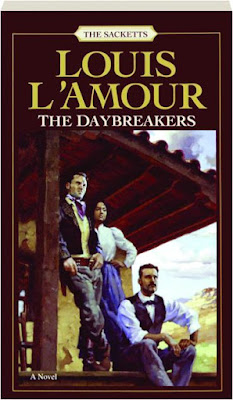
Although no academic would ever mistake L’Amour for a literary author, he is a literate writer of popular fiction who has learned, of himself, many techniques for accomplishing narrative objectives in ways as interesting as they are succinct, and any aspiring writer, whether of horror or another genre, can learn much from the way that he uses carefully chosen words, phrases, clauses, and sentences to set his scenes, suggest action (even when there is none presently taking place), introducing his protagonists, identifying the time of the day and the season of the year, creating suspense, generating a sense of mystery, stating mundane facts in intriguing ways, describing weather, and spotlighting particular characters among other literary personae. He also shows an adept use of similes, metaphors, allusions, personifications, the rhetorical question, and the tall tale (“My Brother [sic] Orrin Sackett, was big enough to fight bears with a switch,” the narrator of The Daybreakers claims). Adapting L’Amour’s techniques and strategies to his or her own genre and work, the aspiring horror writer can do the same.



No comments:
Post a Comment