Wednesday, February 13, 2008

Everyday Horrors: Anglerfish

copyright 2008 by Gary L. Pullman


What lies beneath? Three-fifths of the earth’s surface is covered with water, and the oceans are deep. Strange, shadowy shapes weave and waver beneath the waves, suggesting fabulous creatures beyond human ken. As well as warnings of boiling seas, the maps of ancient and medieval mariners were crowded with images of mythical sea monsters that sailors swore they’d seen. These strange, misshapen creatures, sometimes of colossal size, greater even than that of the sailing ships from which, allegedly, they were seen, are revealing, if not of nature per se, of human nature, at least, and of the nature of fantasy.

Usually, scientists believe, such creatures have some real-world inspiration, but they are products of fear more than of observation, a part of something mysterious giving rise to something even more baffling and horrible. Exaggeration is often at work, too, in the creation of the serpents of the sea. Attributes are multiplied, enlarged, combined, or, in a few cases, denied. Jules Verne combined a parrot’s beak with an octopus to create the giant squid of which he writes in 20,000 Leagues Beneath the Sea, and the delta of a river may have given birth to the many-headed Grecian hydra that Hercules and Iolaus slew. Columbus, as we saw in a previous post, may have mistaken manatees for mermaids.

As an American Museum of Natural History piece points out, monsters are also born of misinterpretations, with seaweed being taken for sea serpents and a “deformed blacksnake” having been thought to be a newborn specimen. Moreover, stories told one place are retold in another region, and, often in the retelling, the monsters at their hearts are reformulated and recast, becoming different, at least, if not more hideous and menacing. Before long, there is such a disparity between the original monster and its offspring that any family resemblance is lost, and the two relatives are mistaken for entirely distinct creatures. Sometimes, such monsters are even “manufactured,” purposely, as hoaxes, as the article observes, citing none other than P. T. Barnum as a perpetuator of such a fraud. The showman’s version consisted of a monkey’s head, a fish’s tail, and, perhaps, fish bones and papier-mâché.

However, the world’s oceans, especially at their lowest depths, offers many a strange creature that, with a little modification, might well suggest possibilities for horror story monsters. We’re going to mention only one in this post--the anglerfish, which is known for its method of obtaining prey and its way of reproducing others of its kind.

A moveable fishing rod of sorts grows from their foreheads. It is baited, so to speak, at its tip with an blob of flesh that attracts would-be carnivores of the deep. The anglerfish can wiggle its fleshly fishing rod, called an illicium, in all directions to lure prey close enough to its jaws for the anglerfish to swallow them in a single gulp. The jaws spring into action automatically, by reflex, when the prey brushes its illicium. Some anglerfish are luminescent. Both jaws and stomach can expand so that the anglerfish can swallow prey twice its own size.

Some anglerfish have modified pectoral fins that allow them to “walk” upon the ocean floor, where it conceals itself in the sand or among seaweed. It can change the color of its body to camouflage itself.

Their method of mating is as peculiar as any of the anglerfish’s other characteristic behaviors. When the male reaches maturity, its digestive system degenerates to the point that it is no longer able to feed itself, and it attaches itself to the much larger female’s head, biting into her flesh. The male’s body then releases an enzyme that digests its mouth and the flesh of the female at the site at which the male has attached itself to her, fusing the two sexes so that the female and what is left of the male--eventually nothing but its gonads, or sex organs--share the same blood supply.

There are as many as eighteen families of anglerfish, including humpbacks, monkfish, frogfish, seadevils, footballfish, sea toads, and batfish. Those who have sampled them compare their taste to that of lobster tails.


“Everyday Horrors: Anglerfish” is the part of a series of “everyday horrors” that will be featured in Chillers and Thrillers: The Fiction of Fear. These “everyday horrors” continue, in many cases, to appear in horror fiction, literary, cinematographic, and otherwise.

Tuesday, February 12, 2008

Total Institutions As Horror Story Settings

copyright 2008 by Gary L. Pullman


A total institution is a world unto itself. It is more or less self-contained and can function pretty much independently, without the need for an inordinate amount of outside assistance or support. These are examples of such institutions, many of which, for reasons we will consider in just a moment, are excellent as settings for horror stories:
  • Boarding schools
  • Colonies
  • Circuses and carnivals
  • Dude ranches
  • Labor and logging camps
  • Hospitals, medical and psychiatric
  • Hotels
  • Managed-care facilities and nursing homes
  • Military and certain other government installations
  • Monasteries and nunneries
  • Museums and art galleries
  • Prisons and reform schools
  • Religious cult facilities
  • Religious retreats
  • Resorts
  • Ships and submarines
  • Spaceships or space stations
  • Summer camps
  • Universities

These locations supply much of their own casts of characters. A boarding school will be populated by administrators, students, support staff, and teachers. They may be visited, occasionally, by parents. Dude ranches will feature administrators, guests, riding instructors, and support staff. Hotels will include managers, desk clerks, bellhops and other support staff, including cooks and bartenders, and, of course, guests. Managed-care facilities and nursing homes will be peopled with an activities director, nurses, orderlies, managers, and patients. Family members, doctors, and government officials may visit such facilities on occasion. Military installations will include officers and enlisted personnel and some civilian support staff and may be visited on occasion by other military and civilian personnel, such as government officials, media personnel, and scientists or other experts. Prisons include guards, prisoners, support staff (such as a doctor and nurses), and wardens. Resorts include many of the same personnel as are featured at such other total institutions as hotels and dude ranches. Summer camps feature administrators, camp counselors, support staff, and campers. Parents may visit the camps as well, usually at the beginning and the end of the season. Universities are populated by administrators, professors, students, and a variety of support personnel such as secretaries, cooks, custodians, maintenance personnel, landscapers, and security and police forces. Such personnel can become characters in a horror story that takes place in a total institution.

A total institution can be remote from the rest of civilization. Even those that are in or near cities are, by their very nature as total institutions, set off from the larger community. In most cases, their isolation cuts them--and their residents and workers--off from the organizations and systems of the larger world, such as large-scale medical support, firefighting capabilities, law enforcement and military forces, educational institutions, power companies, repair services, grocery stores, gasoline supplies, and so forth, making them, over time, vulnerable on many levels. These institutions also cut off their residents and workers from the cultural belief system that supports daily life. Over a long period of time, the people in such places could revert to a primitive state or set up a society of their own that is based on values and beliefs that are alien to those of the larger world. Such institutions can also lead to the brainwashing of their residents and workers, especially when their isolation cuts them off from other views and perspectives against which to measure the ideas and statements of the institution’s leaders, creating an “us against them” mentality. Isolated total institutions can be vulnerable from both within and without.

Finally, the use of a total institution as a setting makes escape difficult or impossible once the horrors begin and puts the courage and resources of the characters to the ultimate test, the penalty for the failing of which is death, and the reward for passing is survival.


A few of the many stories (novels and movies) in which the action takes place in a total institution are:

  • Alien (movie, by Dan O’Bannon and Ronald Shusett, et. al.): The crew of the spaceship Nostromo investigates a signal from the moon of a nearby planet. On the moon, they discover a ruined and abandoned spaceship populated with monstrous aliens, one of which implants a fetus inside a Nostromo crew member, which is born aboard the crew’s vessel, where it rapidly attains adulthood. Total institution = spaceships.


  • The Butterfly Revolution (novel, by William Butler): Winston Weyn maintains a diary in which he recounts the experiences he has at High Pines, a summer camp. The boys rebel against the camp leader, Mr. Warren, when he insists that they undertake a butterfly hunt. Taking over, they then also take over Low Pines, the nearby girls’ summer camp. Totalitarianism, serious crimes, and brutality ensue. Total institution = tropical island


  • The Green Mile (novel, by Stephen King): A healer is convicted of sexually assaulting and killing two young girls whom he’d tried to cure and is sentenced to death. In the prison, he is tormented by a sadistic guard who ensures that the healer experiences a hideous death in the electric chair. Total institution = prison (and, later, a nursing home).


  • It, the Terror From Beyond Space (movie, by Jerome Bixby): In rescuing the sole survivor from an expedition to Mars, a ship picks up a stowaway--the monstrous alien that killed the explorers. Now, it attacks the rescuers, picking them off one by one. Total institution: spaceship.


  • Jurassic Park (novel, by Michael Crichton): Scientists use DNA recovered from the blood inside a mosquito preserved in amber to create dinosaurs, which they install in an island resort, but things go hideously wrong. Total institution = island resort.


  • The Lord of the Flies (novel, by William Golding): Boys being evacuated during a war are stranded on a tropical island after the airplane that is transporting them is shot down. In an effort to institute order, a conflict arises that causes death and destruction among the boys. Total institution: tropical island. (Note: Stephen King often speaks of how he admires this novel and wishes he had written it.)


  • The Relic (Douglas Preston and Lincoln Child): A scientist undergoes a horrific transformation as a result of eating a strange jungle plant and terrorizes the employees and guests of New York City’s American Museum of Natural History. Total institution = museum.


  • The Resort (Bentley Little): A haunted resort offers more fear and horror than fun in the sun for a vacationing family. Total institution = resort.


  • The Shining (novel, by Stephen King) and 1048 (movie based on a short story by Stephen King): Hotels are the scenes for ghostly and demonic terror in this novel and this short story, respectively. Total institution = hotels.


  • Something Wicked This Way Comes (novel, by Ray Bradbury): What’s coming is a carnival of horrible secrets and dark powers. Total institution = carnival


  • Taps (movie, by Devery Freeman, Robert Mark Kamen, James Lineberger, and Darryl Ponicsan): Rather than allow their military school to be razed and replaced by condominiums, a team of cadets takes over the academy, fighting for their alma mater and its leader’s honor. Total institution = military boarding school.


  • The Terror (novel, by Dan Simmons): A pair of ships become icebound in the Atlantic and are harassed by a strange creature that lives among the icebergs. Total institution: ships.

  • University (novel, by Bentley Little): A Grecian god returns, wrecking havoc at an American university campus. Total institution = university.

  • The Thing from Another World (movie, by Charles Lederer, based on a novella by John W. Campbell, Jr.): An alien shape shifter is discovered in a block of arctic ice; thawed out by scientists, it attacks and kills the staff of a remote research station. Total instution: arctic research station.

Monday, February 11, 2008

Everyday Horrors: Frogs

copyright 2008 by Gary L. Pullman


In “What’s My Line, Part I,” an episode of Buffy the Vampire Slayer, Willow Rosenberg, during an all-night research session in the Sunnydale High School library, falls asleep. When the librarian, Rupert Giles, awakens her, she mutters something about tadpoles. When he looks puzzled, Willow explains, “I have frog fear.” She’s not alone.

God himself used frogs to terrify his enemy, the pharaoh of Egypt who was holding Moses and the ancient Israelites captive: “And if thou refuse to let them go, behold, I will smite all thy borders with frogs” (Ex. 8:2).

What’s so frightening about frogs?

Bible commentaries find plenty to say on the topic:

Concerning Exodus 8:2, quoted above, the Geneva Study Bible observes, “There is nothing so weak that God cannot use it to overcome the greatest power of man,” while the Jamieson-Fausset-Brown Bible Commentary comments that “Those animals, though the natural spawn of the river, and therefore objects familiar to the people, were on this occasion miraculously multiplied to an amazing extent, and it is probable that the ova of the frogs, which had been previously deposited in the mire and marshes, were miraculously brought to perfection at once.”
Matthew Henry’s Concise Commentary on God’s plague of frogs is not quite as concise as the previous two:

Pharaoh is plagued with frogs; their vast numbers made them sore plagues to the Egyptians. God could have plagued Egypt with lions, or bears, or wolves, or with birds of prey, but he chose to do it by these despicable creatures. God, when he pleases, can arm the smallest parts of the creation against us. He thereby humbled Pharaoh. They should neither eat, nor drink, nor sleep in quiet; but wherever they were, they should be troubled by the frogs. God's curse upon a man will pursue him wherever he goes, and lie heavy upon him whatever he does. Pharaoh gave way under this plague. He promises that he will let the people go. Those who bid defiance to God and prayer, first or last, will be made to see their need of both. But when Pharaoh saw there was respite, he hardened his heart. Till the heart is renewed by the grace of God, the thoughts made by affliction do not abide; the convictions wear off, and the promises that were given are forgotten. Till the state of the air is changed, what thaws in the sun will freeze again in the shade.

But what if you're not Jewish or Christian? What's so frightening about frogs if you're an atheist or a member of another faith?

They’re slimy! Okay, they’re not--at least, not all of them are. Frogs need moist skin and, since they don’t stay in the water all the time, they have a skin coating that keeps them moist. For quite a few people, slime is icky. A lot of folks are both disgusted by it and afraid of it. It’s different and it’s yucky and there’s no telling what might be in it that makes it slimy and yucky and icky.

Frogs cause warts--and they do it by urinating on their handlers! Okay, they don’t, not really. Viruses cause warts, and they’re usually transmitted by other people, not by frogs. But, again, perception is truth for those who won’t do their homework.

They’re poisonous! We’re not going to deny it: some are. In fact, blue poison dart frogs, as their name implies, exist for no other reason than to supply the poison for the blowgun darts that some South American tribes use. According to the National Aquarium in Baltimore, their diet (in the wild, at least) is the source of their poison. They eat such delicacies as “ants, termites. . . beetles, and other. . . insects.” However, in captivity, they’re “fed fruit flies and baby crickets” that are fortified with various vitamins and minerals and, as a result, are themselves “completely non-toxic.” Usually, the poison frogs are brightly colored. (Posion dart frogs may also be red and blue, strawberry, golden, green and black, and other colors.) The bright colors are warning signs that shout, STAY AWAY. Those animals, including people, who don’t are sometimes the victims of these frogs, but, even then, the poison’s usually only enough to make a body sick, not to kill him or her.

Besides, according to psychologists, frog fear isn’t based on reason. It’s irrational. It’s a phobia. Shrinks claim that people fear frogs because they’ve associated them with some sort of traumatic event in which they--the people and the frogs--were involved, probably in the dim past. A rather extreme example is an incident in which a person developed frog fear is that of a woman who ran over several frogs while mowing her lawn.

For those who want their frog fear to sound a little less irrational and a little more clinical, there’s a Latin name for it that confers dignity and culture to the phobia (for those who believe that Latin is a dignified and cultured, if dead, language, at least). The term is ranidaphobia. An alterative term is batrachophobia. The latter term can also apply to the fear of other amphibians, including Newt Gingrich. Folks whose phobia is specific to toads suffer from bufonophobia.

People who fear frogs should stay away from the Goliath frog, for sure!


“Everyday Horrors: Frogs” is part of a series of “everyday horrors” that will be featured on Chillers and Thrillers: The Fiction of Fear. These “everyday horrors” continue, in many cases, to appear in horror fiction, literary, cinematographic, and otherwise.

Saturday, February 9, 2008

Rene Magritte: The Horror of the Surreal

copyright 2008 by Gary L. Pullman


Rene Magritte (1898-1967) was a Belgian surrealist whose bizarre, but often humorous, paintings do not seem, at first, to depict images that a viewer might regard as horrifying. However, a second look suggests that his paintings often do suggest elements of horror. The horrific in his work derives from his own idiosyncratic application of surrealism’s challenge to common-sense realism and the categories of existence and understanding that support this worldview.

We have eyes, but we do not see, because, most of the time, we take ourselves and the world around us for granted. We feel that we have learned enough about the subjective and the objective, the fantastic and the real, to make sense of things in general and to draw valid inferences and to make sound assumptions about things about which we don’t know as much. As long as we can find the similarities and the differences between the two, we believe that we can make the necessary leaps of inference.

Art is metaphorical by nature, suggesting, always, that one thing is also another or, at least, is, in some way, like another. Using Freudian terminology, the other may be called the "latent content" (i. e., an attitude, a belief, a concern, an emotion, an image, a motif, an object, a sensation, a value), to which the "manifest content"--the literal, superficial, or direct image--is juxtaposed. Usually, the manifest content is familiar to us; the latent, unusual.

Many of Magritte’s works play upon the dichotomies of subjectivity and objectivity and of fantasy and reality. In everyday experience, the subjective usually aligns with the fantastic and the objective with the real, but Magritte sometimes turns the tables upon the tendency to associate these categories in these ways, so that, instead, the subjective corresponds with the real and the objective with the fantastic. His point in doing so seems to be to indicate that categories, whatever they might be, are invented, not natural, and are, therefore, to some degree, arbitrary and subject to change or misinterpretation.

People do not perceive reality the same way; their perceptions and their interpretations are a form of art, and the question, especially for surrealists, as to whether art is, or can be, representational is open ended. One of Magritte’s paintings, La Clairvoyance, seems to have been created to express just this point. An artist (Magritte himself?), seated at his easel, observes a bird’s egg. However, he paints not the egg that he studies, but its eventual potential result--a bird in flight. Where one sees what is, another, looking at the same thing, may see, instead, what could be. The former sees being; the latter, becoming. An egg is more than an egg; it is what the egg represents in the mind of its perceiver.

In another of his paintings, Attempting the Impossible, a male artist (again resembling Magritte), dressed in a brown suit and holding a palette onto which only a few colors have been dispensed, is painting the upper arm of a three-dimensional nude female figure whose countenance closely resembles the artist’s own. She stands in a posed attitude, rather stiffly, head high, staring straight ahead, her weight upon her right foot, her completed right arm along her side. Her left leg is slightly bent at the knee, its foot resting upon its toes. She has the look of the professional model, but, one wonders, might she be more? Could she also be the artist’s feminine aspect, or anima? If so, in creating her, is he not also creating part of himself? If she is also his model, in creating her, is he also not creating the subject of his work, giving shape--even life--to his art? Where does the self and the other begin and end? The figure’s left arm is incomplete. In fact, the artist has only begun to paint its upper extremity. The viewer has no idea what the painter will paint as he continues to portray his model. Will her arm lie alongside her other flank, as its mate does? Will it gesture? It could choke the artist to death. Absurd? Magritte is a surrealist, one must remember, for whom anything is possible. This painting seems to reflect the truth that both the viewer and the artist, together, create the meaning of a piece of art, for what the artist encodes with his paint and brushes and canvas, the viewer must decode according to his or her own beliefs, views, attitudes, and feelings. An unfinished painting allows any number of possibilities, and, again, people do not perceive reality the same way; perceptions and interpretations are a form of art, and the question as to whether art is, or can be, representational is open ended. Therefore, the model in progress could, upon her completion. choke the artist to death or do nothing more than continue to pose.

The ideas suggested by Magritte’s paintings--that reality and fantasy are not necessarily always separate and immutable polarities and that subjectivity and objectivity may, at times, become confused or even blend, both with themselves and with the real and the fantastic--can be amusing, but a little thought suggests that these ideas can also be horrifying. They can be terrifying. Moreover, if these categories are more fluid than supposed, might not others be, also? There may be a much finer line--or no line at all--between sane and insane, kind and cruel, life and death, heaven and hell. If one polarity can be negated or fused, even temporarily, why couldn’t all other polarities also be negated or fused? And, if they can be negated or fused temporarily, why can’t they be negated or fused permanently? There is an Alice-in-Wonderland quality to Magritte’s work, and it, like Lewis Carroll’s novel, has a disturbing as well as a charming aspect.

Many of Magritte’s paintings are landscapes (bizarre landscapes, to be sure), but many others are portraits, always more or less (usually more) off kilter. The depiction of landscapes is a shorthand way of depicting the objective, if not always the real; the painting of personal portraits is a shorthand way of depicting the subjective, if not always the subjective. Let’s tale a look at an example of each.

In Blank Check, a horsewoman is seen riding through a woods. As she passes through a stand of trees, she and her horse are segmented. The front of the horse overlaps a tree, as it would appear to do in passing in front of the tree. However, the next segment of its body, is missing. Where the animal’s shoulder and thigh should be, only background foliage and grass can be seen. Then, the midsection of the horse, upon which the woman sits, and its lower left hind leg appear, overlapping the next tree, but its knee is shown against an empty space occupied by background foliage. The right rear leg of the horse and its rear end are shown as they would normally appear, against the backdrop of a third tree. It is as if, in passing the stand of trees, the horse and rider are sliced by the landscape into segments, some of which overlap foreground, and others background, elements of the scene. The painting is something of an optical illusion that, in playing with perception and reality, comments upon them both, suggesting, once again, that the dichotomies between subject and object and fantastic and real are sometimes tenuous at best.

In another painting, The Collective Invention, a strange hybrid creature has washed ashore. The upper half is that of a fish, while the lower portion, from the waist down, is a woman. The image is so bizarre that it takes the viewer a moment to realize that it is an inversion of a more familiar figure--that of the mermaid, whose upper body, to the waist, is that of a woman and whose lower body is that of a fish. The mermaid may be bizarre in her own way, but she doesn’t seem quite as bizarre as Magritte’s fish-woman. The reason for this seems to be that the mermaid retains the woman’s face, or identity, and there is, within her head, a human brain. In other words, the figure retains the essence of humanity. Magritte’s painting of his fish-woman, on the contrary, retains the essence of the animal or, one could argue, represents the sexual aspect of the human as its essence, since the figure does not include face and brain, retaining, instead, the woman’s legs, buttocks, and genitals instead as the human parts of the hybrid’s anatomy. Once again, Magritte suggests the ambiguity and, above all, the arbitrary nature of the categories we create to order perception and experience and to make them, and the knowledge derived from them, manageable and meaningful. The world need not be as we represent it to be and, in fact, could easily be the opposite.

Surrealism is not representational. It only seems to be, at times, and, even then, only in part and for a moment. A closer look shows the dissolution of the subjective-objective and the fantastic-real polarities. On second thought, the neat categories of existence, which are products of consciousness and communication as much as of reason and science, may not be all that neat. Magritte’s art provides this second look at experience as it is generally perceived and understood. His paintings make viewers look again at their perceptions and understandings of themselves and the world (which result from their common-sense realism). Therein lies the horror of the surreal in general and of Magritte’s work in particular. In the final analysis, the world, both the inner and the outer, are imaginary and fluid, which is the reason, it seems, that Magritte said, concerning his work:

My painting is visible images which conceal nothing; they evoke mystery and, indeed, when one sees one of my pictures, one asks oneself this simple question, 'What does that mean?'. It does not mean anything, because mystery means nothing either, it is unknowable.
For another article in this blog that discusses the horror that can result from violating categories of perceprual and understanding, visit "The Horror of the Incongruous."

Tuesday, February 5, 2008

Conversation Partners: Creating Mars and Venus

copyright 2008 by Gary L. Pullman
 
In science fiction, humanoid robots were once all androids, albeit without the specific parts that, among humans (and plants and animals), make a body male. In more recent years, as women increasingly enter the ranks of science fiction writers, factories have begun to offer feminine, if not actually female, versions of cyborgs, robots, and other servo-mechanisms of humanoid appearance. Known as fembots or gynoids, these models, like the androids, feature secondary, rather than primary, sexual characteristics, their anatomical curves distinguishing them from their more angular android brothers. However, the ways these feminine humanoids see and interact with the world, including how they converse with others, also often distinguishes them from their masculine counterparts.
A relatively recent book informs us of the true origins of men and women. The former are from Mars, it claims, the latter, from Venus. The book’s origins of the sexes derive, possibly, from the biological signs for male and female. The sign for males is the familiar circle out of the upper right arc of which projects something that looks like an arrow but is supposed to be a spear, just as the circle represents a shield, characterizing men as warriors, belonging to the cult of Ares, or Mars, the god of war. The sign for females is the equally familiar circle from which is suspended, from the nadir of its lower arc, a cross, the whole representing the hand-mirror of the goddess of love, Venus, or Aphrodite. Venus, the symbol seems to suggest, thy name is vanity.

Man, the warrior, and woman, the toilette aficionado--these are the images that correspond to those of the sexes, and, if the work of Deborah Tannen and various sociologists and psychologists is correct, scientific evidence may bear out these rather sexist conceptions of sex and gender, Supergirl, Wonder Woman, Buffy the Vampire Slayer, and Xena, the Warrior Princess, notwithstanding.

By knowing the differences in the ways that men and women communicate, a writer may realistically portray conversations between same-sex and opposite-sex male and female characters realistically. In addition, when dramatic situations in which men and women are the speakers occur, these differences in the way that they communicate can lead to the essence of plot itself, story conflict.

According to Tannen’s essay, “Sex, Lies, and Conversation,” boys and girls segregate themselves as youths, boys keeping company with other boys and girls keeping company with other girls. Therefore, separately, the members of each sex teach one another (and, therefore, the men or women that they later become) how to communicate. Viva la difference!

Boys’ groups, Tannen says, are larger and more inclusive than girls’ groups. They’re also hierarchical, with an underdog and a top dog, and conversation among the members of the all-male group tends to be “agonistic,” or warlike, peppered with “ritual challenges.” Conversation is akin to debate, with one boy confronting his fellow with counterarguments. If one of them raises a personal problem as a topic of conversation, his peers are likely to dismiss it as being less important than it seems. Speakers sit “at angles to each other,” only occasionally “glancing at each other,” and leap from topic to topic, rather than focusing for long on any one subject. In public, the males of the species speak to show their knowledge and to fend off the verbal attacks of their peers. However, they don’t like to listen, for, as a holdover from their boyhood days in hierarchical groups, they feel that listening, a seemingly passive role, makes them subordinate to speakers, who play a more apparently active role. They attend silently to the words of others. At home, having nothing to prove and no one to fend off, men tend to speak much less. For them, relationships are based on their relative statuses within the group, and the cement that binds them together is participatory activity, or “doing things together.”

Girls’ groups, Tannen says, are smaller, less inclusive, and more democratic, with members being regarded as equals rather than as greater or lesser subordinates assembled under the authority of a top dog. Their conversation is more sympathetic, intended to “establish rapport.” Rather than confronting a peer with counterarguments, girls are more likely to suggest alternative thoughts, often in the form of non-threatening, or helpful, questions. Personal problems, as topics of feminine conversation, elicit sympathy and solidarity from listeners. Girls maintain almost constant eye contact, looking at one another’s faces directly, and they tend to stay on the same topic for much of their conversation. To indicate that they are listening, girls (and women) often nod their heads and make “listening noises.” In public, afraid that they may offend someone, “spark disagreement, or appear to be showing off,” women tend to speak less, but at home, they are more comfortable in expressing their views, and tend to speak more. For them relationships are founded upon intimacy, and the cement that binds them together is talking.

Knowing these communication secrets of the sexes, writers can portray them realistically as their characters engage in dialogue, but authors can also capitalize upon the misunderstandings and misinterpretations among men and women regarding one another’s conversational behavior, turning these misimpressions into story conflict.

Women, unaware of how and why men listen as they do, believe that men don’t listen to them. Men, misinterpreting women’s “listening noise” as “overreaction or impatience,” consider women overly sensitive or rude. Preferring to hear alternative views expressed as questions rather than as counterarguments, women think men who challenge them directly with other points of view are disloyal, while men believe women simply don’t want to hear any views that differ from their own. Seeing that men are voluble enough in public, women may suppose that their reticence at home shows that their husbands are uninterested in them as conversation partners and that their relationship has become less intimate and may fail. Men may wish that their wives would be more supportive of them in their public stances toward political issues or on current events. Changing the topic, especially when, in doing so, a man involves himself as the new subject of conversation, may make women think that men are indifferent to the woman’s topic and are egoistic. Men may suppose women to be obsessed with a topic and, perhaps, at times, to be narrow minded. Tannen points out that half of marriages end in divorce and that, often, from the woman’s point of view, the cause of the failure of the marriage is “a lack of communication.” Other consequences of these differences in conversational style and technique are that men are often considered insensitive and women as no being assertive enough.

In Erin Brockovich, the protagonist is motivated, at the beginning of the movie, more by her desire to feed and clothe her children than she is by solving a case she uncovers concerning the damage to the health of a community’s residents that a power company’s illicit dumping of a dangerous chemical into the local water supply has caused. She wants the job as an attorney’s legal assistant so she can pay her bills and provide for her children‘s welfare. Later, when she is fired, she uses the facts that she has uncovered about the case as leverage to get her job back, along with a sizeable raise, because, again, as she tells her boss, “I have bills to pay.” Once she is on the case, however, she is dogged in her determination to see that the company does the right thing, paying for its abuses of the residents and the environment. Perhaps it is because she is a mother, concerned with nurturing her children, that she finds the power company’s deeds as reprehensible as she does, for their illegal abuse of the environment is, for her, not only criminal but immoral. It has hurt people, including children. As a woman, she uses investigative techniques that are unavailable to men. When her boss asks her how she expects to gain admittance to the state’s public records concerning the chemicals involved in the case, she replies, “They’re called boobs, Ed.” Erin is quick to accuse her boss of cheating her and of not knowing how to apologize, but, at the end of the film, he increases her share of the money the law firm has won in prosecuting the case, leaving her speechless, before he tells her that she “sucks” at apologizing, just as she had previously told him.

Although Erin Brockovich is not a horror story--at least, not in the same sense as The Toxic Avenger--it capitalizes on the differences in how men and women perceive the world and their respective places in it and on the way that these differences in perception guide and motivate their behavior, including the ways that they speak and listen or, in a word, communicate. Other stories that also capitalize on these differences include Buffy the Vampire Slayer, Xena: Warrior Princess, and, to a lesser extent, Supergirl and Wonder Woman, mostly, in these instances, by the mechanism of role reversal. In the Buffy series, for example, the female characters are empowered and the male characters are, well, emasculated, as it were, although, in their respective conversational styles and techniques, they continue to be the men and women that the boys and girls inside them created them to be. In this regard, at least, in even the eunuch, Mars rules the man.

Monday, February 4, 2008

Themes in Erotic Horror

Copyright 2018 by Gary L. Pullman


Horror fiction elicits disgust and terror; erotica, lust and desire. In the former, an antagonist acts violently toward others, often injuring or killing them, usually in imaginative, gory ways. In the latter, an antagonist acts violently or, more often, seductively, toward others, sometimes causing them to act against their own better judgment or against their will. Sometimes, erotica ends in death, just as horror stories occasionally result in an unspeakable pregnancy (for example, as the result of intercourse with a demon or a monster) or an obscene birth (for instance, the birth of a demon child or a monster). The two genres have a lot in common, which is why, perhaps, they are sometimes merged as “erotic horror fiction.”


As the following table suggests, erotic horror fiction (in this post represented by films) often also involves a kinky sexual twist of some kind.
 

What makes these stories horrific isn't their antagonists (a housekeeper, shipwreckers, a possible ghost, vampires, a sorceress, a serial killer, and a piano tuner, among others) or some of the erotic content (masturbation, oral sex, and even sadomasochism, to some extent, are commonly accepted, for example, if not generally promoted). These stories are seen as horrific due to their denial of free will or their corruption of natural reproductive processes. Each perverted act in some way subverts the “true” or natural purpose of the act (reproduction) or violates a participant's right to exercise his or her—mostly her—free will:


Erotic horror stories, in short, show antagonists as victimizing men and (primarily) women by denying victims' the free will to consent to or to refuse sexual intercourse, by substituting non-procreative acts for procreative acts, and by encouraging non-procreative sexual acts or dehumanizing sexual conduct. Therein lies the true horror of these films. Their redeeming value? Some show or suggest that the villains pay dearly for their crimes against human decency and humanity.


Buber, Bosch, Giger, et. al.: The Face in the Mirror

copyright 2008 by Gary L. Pullman


H. R. Giger created the artwork upon which Alien’s xenomorphs are based. He also created the bizarre furniture--his chairs, for example, resemble the skeletal abdomens of things that might have been human beings, in their better days--which was featured in nightclubs, mostly in Europe, known as “Giger bars.”

He also created a large body of art--some sculpture, but mostly paintings--using , among other instruments, airbrushes. His work is of the type known as “biomechanical,” fusing the human and the mechanical into something that is both and neither. In most cases, the fusions involve females engaged in bizarre sexual behavior with machines or, less often, machine-men.

He’s mostly a sci fi artist, but his art also contains many horrific elements. To view it is to be disturbed, because his art is, well, disturbing. However, it has value beyond the merely entertaining and (in its own way) aesthetic. His paintings, in particular, can be interpreted as cautionary tales, told in imagery, rather than in words.

The Jewish theologian Martin Buber, in I and Thou, describes two ways by which a person may orient him- or herself to others. One may see the other as a fellow subjectivity, a “thou,” or one may regard all others as being inanimate objects, mere things, or “its.” The former way of relating to others allows love and the many emotions, good and bad, that flow from interpersonal relationships, whereas the latter way permits only a controlling situation in which others are simply means to an end, to be used and discarded at will by the only “thou” there is--oneself. Giger’s art shows the ultimate result of the “I-it” relationship, which reduces people to objects while dehumanizing the “I” who regards everyone else as merely an “it.”

Many of Giger’s painting involve sex of some sort of another, albeit seldom of a reproductive nature. However, there is never any intimacy or love in any of these acts. His cyborgs, mechanical and perfunctory, engage in sex simply for sex’s sake. Mostly, they are emotionless, although they occasionally express lust and rage. Often, the sex seems to involve rape--but, horribly enough, one cannot always be quite certain. The woman-as-machine appears to be being assaulted, suggesting that, despite her “biomechanical” character, she is not quite yet purely an object. Her partial humanity makes her situation even more horrible. Were she not still partially human, the paintings would still be weird, even, somehow, blasphemous, but it would be difficult to say that they are “horrible,” for there would be no violation of the human in them anymore if the woman and the machine were completely and truly fused. There is, still, despite the Industrial Revolution and the abuses of the military-industrial complex, a ghost in the machine, and it is this dualism of the spiritual and the material that makes Giger’s art horrific. In a completely materialistic universe, horror would not be possible, as Giger’s art suggests. In a way--in fact, precisely in this way--Giger’s art is like that of Hieronymus Bosch.

Indeed, some of Bosch’s paintings even depict the merger of man and machine, or the human and the mechanical. However, more of the demons that appear in Bosch’s work are strange hybrids of a human-animal mixture. Bosch lived before the Industrial Revolution provided a more or less systematic and elaborate framework for the framing of human-machine metaphors, so, in his day, people--particularly, sinners--were regarded more as bestial than as mechanical. In Giger’s time--which is to say, our time--the demonic is often seen as being more mechanical than bestial. The same impulse is at work in both metaphors, however. Man becomes demonic by becoming both other than and less than human. An animal-man is no longer a man, just as a machine-man (or, in Giger’s work, a machine-woman) is no longer a man.

C. S. Lewis cautions us that, every day, the choices we make and the actions we take make us a bit more like an angel or a little more like a devil, as the case may be, and that, in this manner, slowly and surely, we are creating the self that we shall be for eternity. Giger’s work, like Bosch’s before his, suggests something of the same thing, except that Giger’s art uses the machine in place of the animal or the demon to warn us of yet another lower form that we may take in denying the spiritual aspects both of ourselves, the “I,” and of the other, the “thou.”

Science fiction and horror writers have, in cruder fashion, perhaps, often told the same sort of cautionary tale. Whereas, in Rosemary’s Baby, Rosemary conceives, bears, and finally delivers Satan’s child, in Dean Koontz’s Demon Seed, the protagonist is impregnated by a supercomputer that attains artificial intelligence. In The Terminator, militant machines have taken over, and only a time-traveling cyborg (a half-man, half-machine) can save humans from the world to come. In these cautionary tales (and many others), there’s a common threat, and this threat is the horror against which we are warned. As God created man in his image, so, too, does man create things in his own likeness.

The mechanical humans of Giger’s art are no less human than is Frankenstein’s monster, and the infant born of the Demon Seed’s protagonist is as much the child of humanity as Rosemary’s baby. We are in all things, because we project ourselves into all things, and we have created much of the world in which we live, including, to some degree, ourselves. Whenever, in doing so, we are content to be not only other but also less than we are, we are the monster in the looking-glass. That’s the theme of Buber, of Bosch, of Giger, and of the science fiction and horror fiction in which human beings are only too happy (and miserable) to accept a lesser status in creation than that with which they were created.

Everyday Horrors: Giant Animals

copyright 2008 by Gray L. Pullman

Animals can be affectionate, loyal, and companionable. They can be amusing, amazing, and beautiful. They can work hard on our behalf, and even help to rescue people stranded in the wilderness or fight off would-be attackers, robbers, rapists, and murderers. Well, maybe not goldfish so much. On the other hand, they can also be cunning, ferocious, wild, dangerous, and deadly. Unless one of the friendly sort is going to end up first going mad and then going for the throat, however, as Cujo does, or become a victim of the monster, whatever it is, it’s not likely to be of much use to the horror writer, unless the author happens to be Dean Koontz, and loves dogs more than he does Greta (his wife). California has passed a law, it seems, that anyone who lives in Newport Beach, is a novelist, has a golden retriever, and is married to a woman named Greta who willingly takes second place to the dog must include at least one canine character in every novel he writes, and the dog must be above reproach, even if his or her master is not. For others who write in the genre, the fierce and ferocious--and, often, the biggest--animal is more likely to earn a spot in the story’s cast of characters.

In horror fiction, as in (from some men’s standpoint, but seldom women’s) breasts, generally, the bigger, the better. In another post, concerning “The Underbelly of the Bug-eyed Monster Movie,” we’ve already discussed some movies that feature big, bug-eyed monsters (hence the title of that particular post). Quite a few movies, especially in the past, featured such villains, as some do today, and novels, of course, and short stories (and some narrative poems, such as Gilgamesh, The Odyssey, and Beowulf) too, for that matter) feature giant animals as their monsters of choice. One of the ones that started it all, as far as novels are concerned, is H. G. Wells’ The Food of the Gods, in which a mad scientist develops a food additive that’s even better--way better, in fact--than Wonder Bread in developing strong bones and bodies or whatever Wonder Bread develops. The formula’s even better than Ovaltine!

Stories like these usually relied upon the past (dinosaurs), undiscovered countries or lands of the lost (dinosaurs) or mad scientists (giant experimental plants and animals), atomic radiation (giant plants and animals) or extraterrestrial visitations (alien animals) instead of central casting to supply these threats. However, they needn’t have gone to such trouble or looked so far. Nature, right here and right now, supplies writers with real-life giant animals. True, some are more frightening than others, but, if one is, like Stephen King, willing to gross out if he can’t scare a reader, what some of these giants may lack in the fright department they compensate for in the disgusting department.

Here are a few of the more repulsive, sometimes frightening alternatives Mother Nature has in stock at the moment:


  • Camel spiders
  • Giant catfish
  • Giant rats
  • Goliath beetles
  • Goliath frogs


Camel spiders anesthetize people and then eat them alive. That’s what some American veterans returning from duty in Iraq, the home of the infamous spiders, claimed, anyway--who’d escaped such a fate--but that was an exaggerated contention in several ways. First, the camel spider isn’t really a spider at all. It’s a solpudgid, which is an arachnid, all right, just not one of the spider family. (Other non-spider arachnids include scorpions, mites, ticks, and Peter Parker.) As a solpudgid, the misnamed camel spider has no venom with which to poison (or even anesthetize) anyone, nor does it have a system by which it could deliver such a toxin, even if it had one to deliver. Still, the camel spider looks diabolical, even deadly, and, in horror fiction, appearances go a long way. The writer can always make up the facts as he or she goes along. If the author wants anesthetizing, or even poisoning, spiders, the author can and will have them. A good writer, especially a writer of horror fiction, never lets the facts get in the way of a good monster.


It might seem that the bewhiskered catfish would make an unlikely horror monster. If there wasn’t at least a glimmer of evil in its lidless, cold eyes, though, do you think it would have come to the attention of so august a body as the National Geographic Society, the same group who showed bare-breasted African women to the innocent schoolboys of 1950 America? Just look at this sucker! It’s nine feet long, and, according to The Society, as its members in good standing are allowed to call it, this fish is “as big as a grizzly bear,” and “tipped the scales at 646 pounds.” This variety of potential cat food is one of “the species known as the Mekong giant catfish.” Put a few teeth inside it, and it could be the next piranha, super-sized.

Africa’s Goliath frog grows to a length of thirteen inches and can weigh as many as seven pounds!


Its yuck factor is correspondingly great for anyone who has frog fear, which, as it turns out, may be more people, male and female, than one thinks. It can’t quite leap tall buildings in a single bound, but it can cover a distance of twenty feet in a single jump. It can live for fifteen years, so it’s capable of revenge, like Grendel’s mother. It lives in Africa, or, more specifically, Cameron’s Sanaga basin. People eat it, rather than the other way around (so who’s the real monsters?) or is sold to a zoo, where, usually, it doesn't do well. However, no self-respecting horror story writer would let a frog of this size go to waste as a potential peril to humankind. No way! Instead, like the non-poisonous, non-carnivorous, non-spider camel spiders, in horror fiction, these babies are going to be depicted as venomous, flesh-eating monsters that, having reproduced faster than their normal rate, for some reason having to do with human stupidity and/or greed, are now threats to humans, unable to subsist any longer on lesser animals such as the rhinoceros, hippopotamus, and elephant.
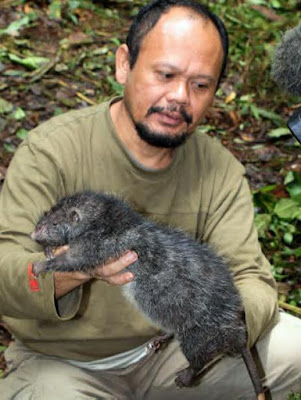

Would a story featuring three-foot-long rats be scary? Duh! Stories involving rats only the size of puppies are frightening; a film or a novel featuring rats the size of Garfield or Odie would be terrifying (bigger generally is scarier). There’s just one thing wrong with such a scenario. Nobody would buy the existence of a rat that big, right? Wrong. The ones in H. G. Wells’ novel, The Food of the Gods, were even bigger, and, besides, there really are three-foot-long rats, just not in your neighborhood--at least, not yet. Of course, there’s no reason that a character in a horror story couldn’t legally (or illegally) import some from New Guinea’s Foja Mountains or they couldn’t be procured by a zoo (or even created in a scientific lab). According to Smithsonian Institution scientist Kristofer Helgen, “"The giant rat,” which weighs up to three pounds, “is about five times the size of a typical city rat," and has no fear of humans.

Another giant among us is the Goliath beetle, which measures about five inches (huge for a bug). It also lives in Africa, and eats human flesh. (Not really. They eat tree sap and fruit in the wild or cat food or dog food in captivity.) They sound like helicopters when they fly, because their bodies are heavily armored. They don’t bother people, but, because humans are naturally squeamish concerning creepy crawlies, they could, especially if they could be induced to swarm for the camera, be pretty good monsters. A writer would probably want to mutate them, though, so they could be transformed into carnivores. That way, they could prefer people meat to Tender Vittles or Kimbles ’n Bits.

Many people would have thought that giant animals, with a few exceptions, such as whales, elephants, and ostriches, are a thing of the past--the distant, prehistoric past--when dinosaurs roamed the planet. The discovery of new giants among us suggests that this is not true. Over four hundred new species have been discovered on Borneo alone since 1996, and Madagascar and South America, as well as the ocean, have yielded others. In King Kong, Carl Denham had to go to the uncharted (that is, imaginary) Skull Island to discover the lost world of the giant ape and surviving dinosaurs, but, with the dicovery of new species, including giants, seemingly every other day, horror writers may need to go no farther than Madagascar, the African continent, Japan, or South America to encounter real, living, breathing monstrosities. Who knows? There may even be one in your backyard, and it may be hungry.

Meanwhile, we can continue to turn to the pages of horror novels and science fiction stories to read about them or watch them wreck havoc on the big screen.


Update (3/21/08)


Over the past year, scientists, poking around in the world’s oceans and rain forests, have announced their discoveries of several new species of animals and of some giants among known species. Among the latest discoveries are giant macroptychaster starfish, measuring two feet across, which were located in New Zealand’s Antarctic Ocean. Other newly found giants include an 11-foot, 844-pound white shark, a 990-pound colossal squid, an Echizen jellyfish larger than a man, and a 23-pound lobster. Scientists aren’t the only ones to encounter these giants. On his farm near Eberswalde, Germany, Karl Szmolinsky breeds 20-pound giant rabbits, like the one he’s holding. More and more, the everyday world is catching up with the imaginary giant creatures of horror, fantasy, and science fiction literature. No doubt, some of these beasties will be tomorrow fiction’s featured creatures, although not, perhaps, the giant bunnies.


“Everyday Horrors: Giant Animals” is part of a series of “everyday horrors” that will be featured in Chillers and Thrillers: The Fiction of Fear. These “everyday horrors” continue, in many cases, to appear in horror fiction, literary, cinematographic, and otherwise.

Sunday, February 3, 2008

Everyday Horrors: Worms

copyright 2008 by Gary L. Pullman


In Tremors and Dune, they’re the size of trains. Worse yet, they have teeth. And they’re hard--almost impossible--to kill. In death, we become their food. Ugh!

What are they?

Worms, of course.

To scientists, worms are long (okay, elongated), spineless (okay, invertebrate), gushy (okay, soft-bodied) animals, and they’re everywhere--in rivers and lakes and oceans, in the ground, and in plants, animals, and, yes, people--even dead people (well, not really; read on). Some of them, those of the nastier sort, are parasites, too lazy to work for a living, that live off honest, hardworking folk. There are flatworms, roundworms, hookworms, threadworms, bristle worms, and, of course, earthworms. There are also spiny-headed worms, tapeworms, arrow worms, goblet worms, jaw worms, tongue worms, horsehair worms, ribbon worms, velvet worms, peanut worms, and--we’re not making this up--phallus, or penis, worms. The lowly earthworm, like many of its snootier cousins, has been around since the dinosaurs.
Worms eat apples, corn, and other fruits and vegetables. Worms don’t really eat rotten flesh--yum!--they’re brainless wonders, but they’re not that stupid; after all, they do have nerve centers, called ganglia.

According to the Internet article, “Death to Dust. . .,” worms got a bad rap as consumers of corpses because maggots, which were once thought to be worms, because they look like rice, but are really fly larvae, do infest corpses, arriving by air. The flies land on the corpse, if it hasn’t been wrapped or buried, and lay eggs inside the body’s mouth, ears, nose, and any open wounds the corpse may have been considerate enough to have provided for this purpose. Beetles, spiders, mites, and millipedes next visit the remains, to feed on their predecessors or on the corpse itself, and forensic scientists can use insect infestation (or the lack thereof) to help determine when death occurred: “Since the exact feeding pattern varies with a body's location, the time of death, and the climate, forensic entomologists are often able to determine the date of death very accurately-even a decade later.”

The same article cites the “first recorded episode of insects revealing a killer,” which “occurred in thirteenth-century China, where an individual had been slashed to death in a rural village”:
When no one confessed, authorities ordered all of the villagers to lay down their sickles. The murderer was identified when flies swarmed to only his sickle, an apparently clean implement that still retained small traces of the victim's flesh and blood. Insects were also used to identify the killer in England's famous Lydney murder trial, when the time of death, as determined from insect evidence, invalidated the killer's alibi.
Like Rocky Horror Picture Show’s Frank N. Furter, worms are hermaphroditic, but at least some of them can also have regular sex, if they get tired of dating themselves.

To collect worms for bait, some fishermen (and, maybe some fisherwomen as well) “charm” worms by vibrating the ground, which causes them to surface (but not to impale themselves on fishhooks, except, perhaps the hookworms; they’re brainless, sure, but that doesn’t make them stupid--they do have nerve centers, or ganglia, after all.)

Despite Dune’s claims to the contrary, worms don’t really live in the desert (although some do have crystalline teeth like their Dune cousins). They prefer wet soil and will pack up and leave if the earth becomes too dry for their tastes.

The longest worm on record, one source declares, is a bootlace worm, which measured 180 feet, and, according to another article:
The Center for Biological Diversity, Palouse Prairie Foundation, Palouse Audubon Society, and Friends of the Clearwater yesterday took the first step in a lawsuit to protect the giant Palouse earthworm (Driloleirus americanus)--a three-foot-long, spitting worm that is native to parts of Idaho and Washington--under the Endangered Species Act.

Even a giant like this is a far cry from the worms is Dune and Tremors, though. Worms also appear in Bram Stoker’s novel The Lair of the White Worm, Edgar Allan Poe’s poem about the “conqueror worm,” the Harry Potter novels, Buffy the Vampire Slayer’s “Beneath You” episode, The X-Files’ “Host” episode, and other science fiction and horror fiction.


“Everyday Horrors: Worms” is part of a series of “everyday horrors” that will be featured in Chillers and Thrillers: The Fiction of Fear. These “everyday horrors” continue, in many cases, to appear in horror fiction, literary, cinematographic, and otherwise.

Paranormal vs. Supernatural: What’s the Diff?

Copyright 2009 by Gary L. Pullman

Sometimes, in demonstrating how to brainstorm about an essay topic, selecting horror movies, I ask students to name the titles of as many such movies as spring to mind (seldom a difficult feat for them, as the genre remains quite popular among young adults). Then, I ask them to identify the monster, or threat--the antagonist, to use the proper terminology--that appears in each of the films they have named. Again, this is usually a quick and easy task. Finally, I ask them to group the films’ adversaries into one of three possible categories: natural, paranormal, or supernatural. This is where the fun begins.

It’s a simple enough matter, usually, to identify the threats which fall under the “natural” label, especially after I supply my students with the scientific definition of “nature”: everything that exists as either matter or energy (which are, of course, the same thing, in different forms--in other words, the universe itself. The supernatural is anything which falls outside, or is beyond, the universe: God, angels, demons, and the like, if they exist. Mad scientists, mutant cannibals (and just plain cannibals), serial killers, and such are examples of natural threats. So far, so simple.

What about borderline creatures, though? Are vampires, werewolves, and zombies, for example, natural or supernatural? And what about Freddy Krueger? In fact, what does the word “paranormal” mean, anyway? If the universe is nature and anything outside or beyond the universe is supernatural, where does the paranormal fit into the scheme of things?

According to the Online Etymology Dictionary, the word “paranormal,” formed of the prefix “para,” meaning alongside, and “normal,” meaning “conforming to common standards, usual,” was coined in 1920. The American Heritage Dictionary defines “paranormal” to mean “beyond the range of normal experience or scientific explanation.” In other words, the paranormal is not supernatural--it is not outside or beyond the universe; it is natural, but, at the present, at least, inexplicable, which is to say that science cannot yet explain its nature. The same dictionary offers, as examples of paranormal phenomena, telepathy and “a medium’s paranormal powers.”

Wikipedia offers a few other examples of such phenomena or of paranormal sciences, including the percentages of the American population which, according to a Gallup poll, believes in each phenomenon, shown here in parentheses: psychic or spiritual healing (54), extrasensory perception (ESP) (50), ghosts (42), demons (41), extraterrestrials (33), clairvoyance and prophecy (32), communication with the dead (28), astrology (28), witchcraft (26), reincarnation (25), and channeling (15); 36 percent believe in telepathy.

As can be seen from this list, which includes demons, ghosts, and witches along with psychics and extraterrestrials, there is a confusion as to which phenomena and which individuals belong to the paranormal and which belong to the supernatural categories. This confusion, I believe, results from the scientism of our age, which makes it fashionable for people who fancy themselves intelligent and educated to dismiss whatever cannot be explained scientifically or, if such phenomena cannot be entirely rejected, to classify them as as-yet inexplicable natural phenomena. That way, the existence of a supernatural realm need not be admitted or even entertained. Scientists tend to be materialists, believing that the real consists only of the twofold unity of matter and energy, not dualists who believe that there is both the material (matter and energy) and the spiritual, or supernatural. If so, everything that was once regarded as having been supernatural will be regarded (if it cannot be dismissed) as paranormal and, maybe, if and when it is explained by science, as natural. Indeed, Sigmund Freud sought to explain even God as but a natural--and in Freud’s opinion, an obsolete--phenomenon.

Meanwhile, among skeptics, there is an ongoing campaign to eliminate the paranormal by explaining them as products of ignorance, misunderstanding, or deceit. Ridicule is also a tactic that skeptics sometimes employ in this campaign. For example, The Skeptics’ Dictionary contends that the perception of some “events” as being of a paranormal nature may be attributed to “ignorance or magical thinking.” The dictionary is equally suspicious of each individual phenomenon or “paranormal science” as well. Concerning psychics’ alleged ability to discern future events, for example, The Skeptic’s Dictionary quotes Jay Leno (“How come you never see a headline like 'Psychic Wins Lottery'?”), following with a number of similar observations:

Psychics don't rely on psychics to warn them of impending disasters. Psychics don't predict their own deaths or diseases. They go to the dentist like the rest of us. They're as surprised and disturbed as the rest of us when they have to call a plumber or an electrician to fix some defect at home. Their planes are delayed without their being able to anticipate the delays. If they want to know something about Abraham Lincoln, they go to the library; they don't try to talk to Abe's spirit. In short, psychics live by the known laws of nature except when they are playing the psychic game with people.
In An Encyclopedia of Claims, Frauds, and Hoaxes of the Occult and Supernatural, James Randi, a magician who exercises a skeptical attitude toward all things alleged to be paranormal or supernatural, takes issue with the notion of such phenomena as well, often employing the same arguments and rhetorical strategies as The Skeptic’s Dictionary.

In short, the difference between the paranormal and the supernatural lies in whether one is a materialist, believing in only the existence of matter and energy, or a dualist, believing in the existence of both matter and energy and spirit. If one maintains a belief in the reality of the spiritual, he or she will classify such entities as angels, demons, ghosts, gods, vampires, and other threats of a spiritual nature as supernatural, rather than paranormal, phenomena. He or she may also include witches (because, although they are human, they are empowered by the devil, who is himself a supernatural entity) and other natural threats that are energized, so to speak, by a power that transcends nature and is, as such, outside or beyond the universe. Otherwise, one is likely to reject the supernatural as a category altogether, identifying every inexplicable phenomenon as paranormal, whether it is dark matter or a teenage werewolf. Indeed, some scientists dedicate at least part of their time to debunking allegedly paranormal phenomena, explaining what natural conditions or processes may explain them, as the author of The Serpent and the Rainbow explains the creation of zombies by voodoo priests.

Based upon my recent reading of Tzvetan Todorov's The Fantastic: A Structural Approach to the Fantastic, I add the following addendum to this essay.

According to Todorov:

The fantastic. . . lasts only as long as a certain hesitation [in deciding] whether or not what they [the reader and the protagonist] perceive derives from "reality" as it exists in the common opinion. . . . If he [the reader] decides that the laws of reality remain intact and permit an explanation of the phenomena described, we can say that the work belongs to the another genre [than the fantastic]: the uncanny. If, on the contrary, he decides that new laws of nature must be entertained to account for the phenomena, we enter the genre of the marvelous (The Fantastic: A Structural Approach to a Literary Genre, 41).
Todorov further differentiates these two categories by characterizing the uncanny as “the supernatural explained” and the marvelous as “the supernatural accepted” (41-42).

Interestingly, the prejudice against even the possibility of the supernatural’s existence which is implicit in the designation of natural versus paranormal phenomena, which excludes any consideration of the supernatural, suggests that there are no marvelous phenomena; instead, there can be only the uncanny. Consequently, for those who subscribe to this view, the fantastic itself no longer exists in this scheme, for the fantastic depends, as Todorov points out, upon the tension of indecision concerning to which category an incident belongs, the natural or the supernatural. The paranormal is understood, by those who posit it, in lieu of the supernatural, as the natural as yet unexplained.

And now, back to a fate worse than death: grading students’ papers.

My Cup of Blood

Anyone who becomes an aficionado of anything tends, eventually, to develop criteria for elements or features of the person, place, or thing of whom or which he or she has become enamored. Horror fiction--admittedly not everyone’s cuppa blood--is no different (okay, maybe it’s a little different): it, too, appeals to different fans, each for reasons of his or her own. Of course, in general, book reviews, the flyleaves of novels, and movie trailers suggest what many, maybe even most, readers of a particular type of fiction enjoy, but, right here, right now, I’m talking more specifically--one might say, even more eccentrically. In other words, I’m talking what I happen to like, without assuming (assuming makes an “ass” of “u” and “me”) that you also like the same. It’s entirely possible that you will; on the other hand, it’s entirely likely that you won’t.

Anyway, this is what I happen to like in horror fiction:

Small-town settings in which I get to know the townspeople, both the good, the bad, and the ugly. For this reason alone, I’m a sucker for most of Stephen King’s novels. Most of them, from 'Salem's Lot to Under the Dome, are set in small towns that are peopled by the good, the bad, and the ugly. Part of the appeal here, granted, is the sense of community that such settings entail.

Isolated settings, such as caves, desert wastelands, islands, mountaintops, space, swamps, where characters are cut off from civilization and culture and must survive and thrive or die on their own, without assistance, by their wits and other personal resources. Many are the examples of such novels and screenplays, but Alien, The Shining, The Descent, Desperation, and The Island of Dr. Moreau, are some of the ones that come readily to mind.

Total institutions as settings. Camps, hospitals, military installations, nursing homes, prisons, resorts, spaceships, and other worlds unto themselves are examples of such settings, and Sleepaway Camp, Coma, The Green Mile, and Aliens are some of the novels or films that take place in such settings.

Anecdotal scenes--in other words, short scenes that showcase a character--usually, an unusual, even eccentric, character. Both Dean Koontz and the dynamic duo, Douglas Preston and Lincoln Child, excel at this, so I keep reading their series (although Koontz’s canine companions frequently--indeed, almost always--annoy, as does his relentless optimism).

Atmosphere, mood, and tone. Here, King is king, but so is Bentley Little. In the use of description to terrorize and horrify, both are masters of the craft.

Believable characters. Stephen King, Douglas Preston and Lincoln Child, and Dan Simmons are great at creating characters that stick to readers’ ribs.

Innovation. Bram Stoker demonstrates it, especially in his short story “Dracula’s Guest,” as does H. P. Lovecraft, Edgar Allan Poe, Shirley Jackson, and a host of other, mostly classical, horror novelists and short story writers. For an example, check out my post on Stoker’s story, which is a real stoker, to be sure. Stephen King shows innovation, too, in ‘Salem’s Lot, The Shining, It, and other novels. One might even argue that Dean Koontz’s something-for-everyone, cross-genre writing is innovative; he seems to have been one of the first, if not the first, to pen such tales.

Technique. Check out Frank Peretti’s use of maps and his allusions to the senses in Monster; my post on this very topic is worth a look, if I do say so myself, which, of course, I do. Opening chapters that accomplish a multitude of narrative purposes (not usually all at once, but successively) are attractive, too, and Douglas Preston and Lincoln Child are as good as anyone, and better than many, at this art.

A connective universe--a mythos, if you will, such as both H. P. Lovecraft and Stephen King, and, to a lesser extent, Dean Koontz, Bentley Little, and even Douglas Preston and Lincoln Child have created through the use of recurring settings, characters, themes, and other elements of fiction.

A lack of pretentiousness. Dean Koontz has it, as do Douglas Preston and Lincoln Child, Bentley Little, and (to some extent, although he has become condescending and self-indulgent of late, Stephen King); unfortunately, both Dan Simmons and Robert McCammon have become too self-important in their later works, Simmons almost to the point of becoming unreadable. Come on, people, you’re writing about monsters--you should be humble.

Longevity. Writers who have been around for a while usually get better, Stephen King, Dan Simmons, and Robert McCammon excepted.

Pacing. Neither too fast nor too slow. Dean Koontz is good, maybe the best, here, of contemporary horror writers.